Tag Archives: Spurs

Frank vs De Zerbi – a deeper dive

In my last post I looked at some statistics that demonstrated how the performances at Spurs improved when we swapped the turgid football of Thomas Frank for the sunlit uplands of De Zerbi-ball. Continuing this theme, I thought I’d use some more advanced metrics to take a deeper dive into their contrasting styles, with the help of the wealth of data available online, and a copy of Claude Code.

Caveat: There is one big problem that makes this exercise interesting but not particularly scientific. Whilst we have a relatively large sample size for Frank, we have just seven games for De Zerbi, against arguably a relatively easy set of opponents. I still think it’s interesting to crunch the numbers but take them with a pinch of salt.

Caveat 2: I used data scraped from the various sites on the internet and built my own models using Claude Code. Therefore my models and data may not 100% align with others, although they do seem pretty close and I have carefully cross checked the logic / data.

Note: the graphs are presented with positive metrics being up and to the right, this sometimes means the numbers on the axes are reversed.

Attacking

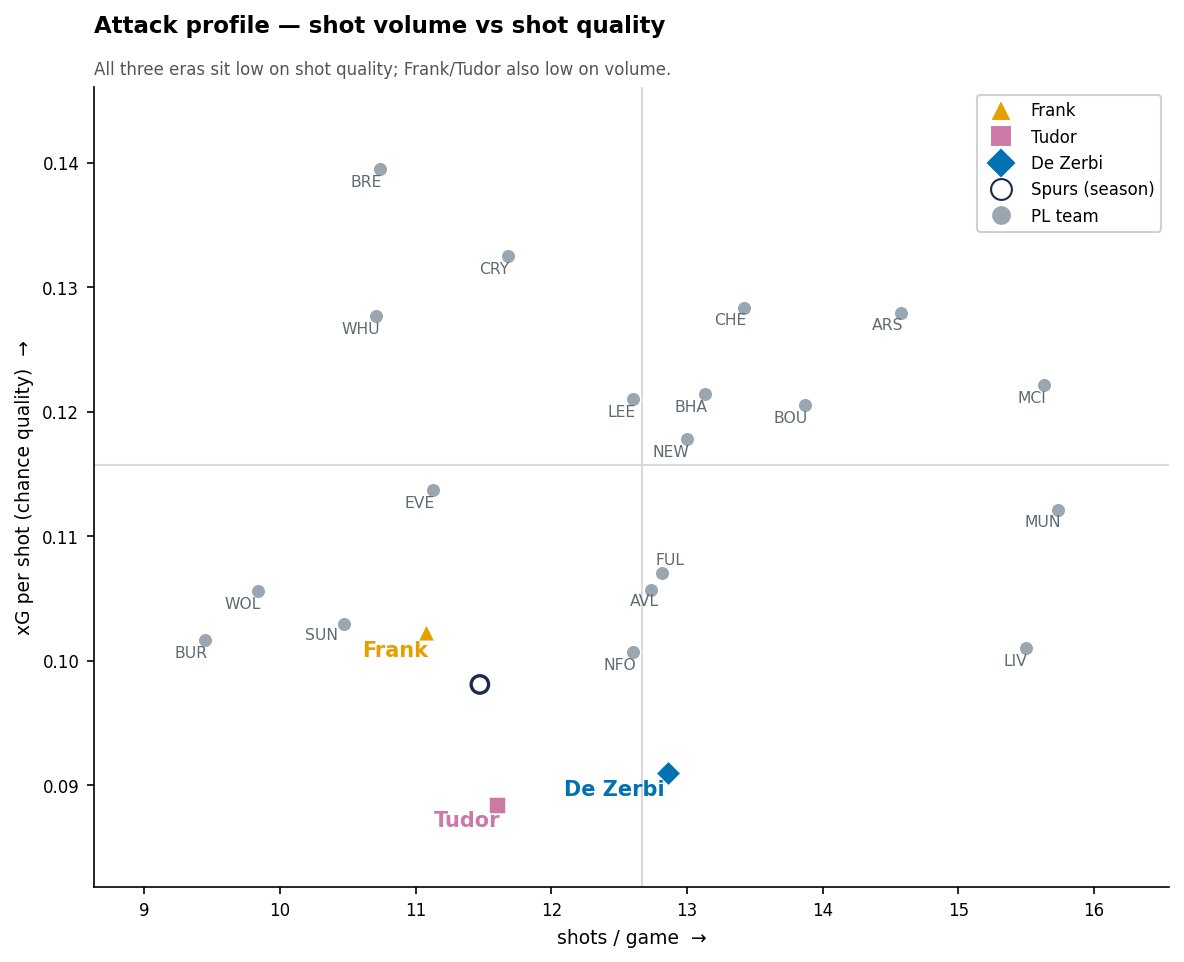
De Zerbi is most known for his team’s style when they have possession. It’s interesting that while shot volume increased to above the league average, shot quality actually decreased to worse than any individual team. It wasn’t an improvement in our attack that kept Tottenham up.

Given the little time available to the Italian, and the lack of a transfer window, this isn’t that surprising.

Defending

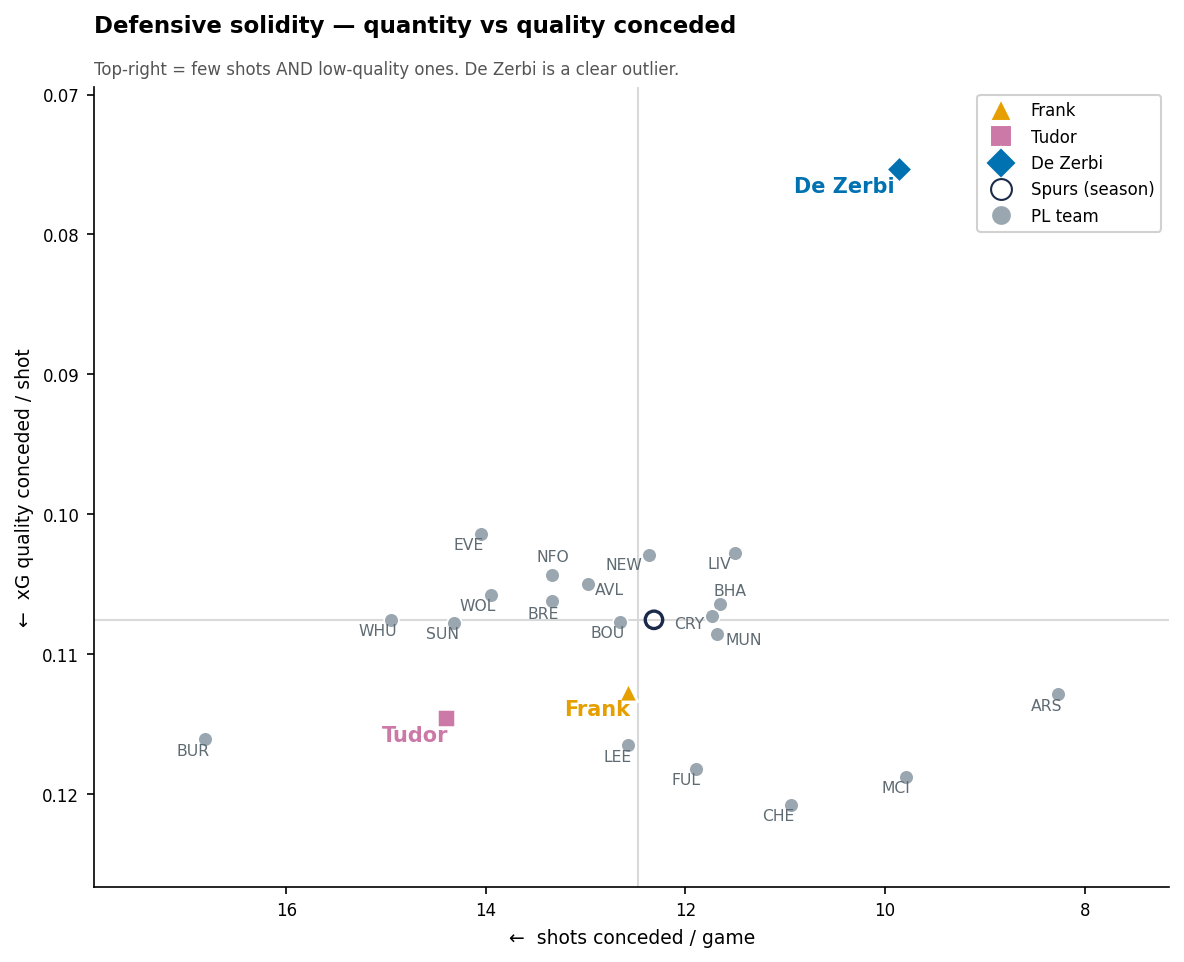
It was actually the defensive side of the ball that saw the most impact from the change of coach, and what an impact. Both the opposition’s shot volume, and the quality of those chance fell dramatically, to the extent that De Zerbi’s time in charge is a massive outlier. This is probably exaggerated by the small sample size, the context of a relegation battle, and the difficulty of the opponents faced. Even given those caveats, this seems a strong enough signal that something fundamental had changed.

Frank conceded around average shot volumes, but the chances conceded were above average opportunities to score. It’s interesting to see league leaders Arsenal and Manchester City gave up similarly high quality chances, but also noticeable that these were in much lower volumes.

Pressing and Winning The Ball

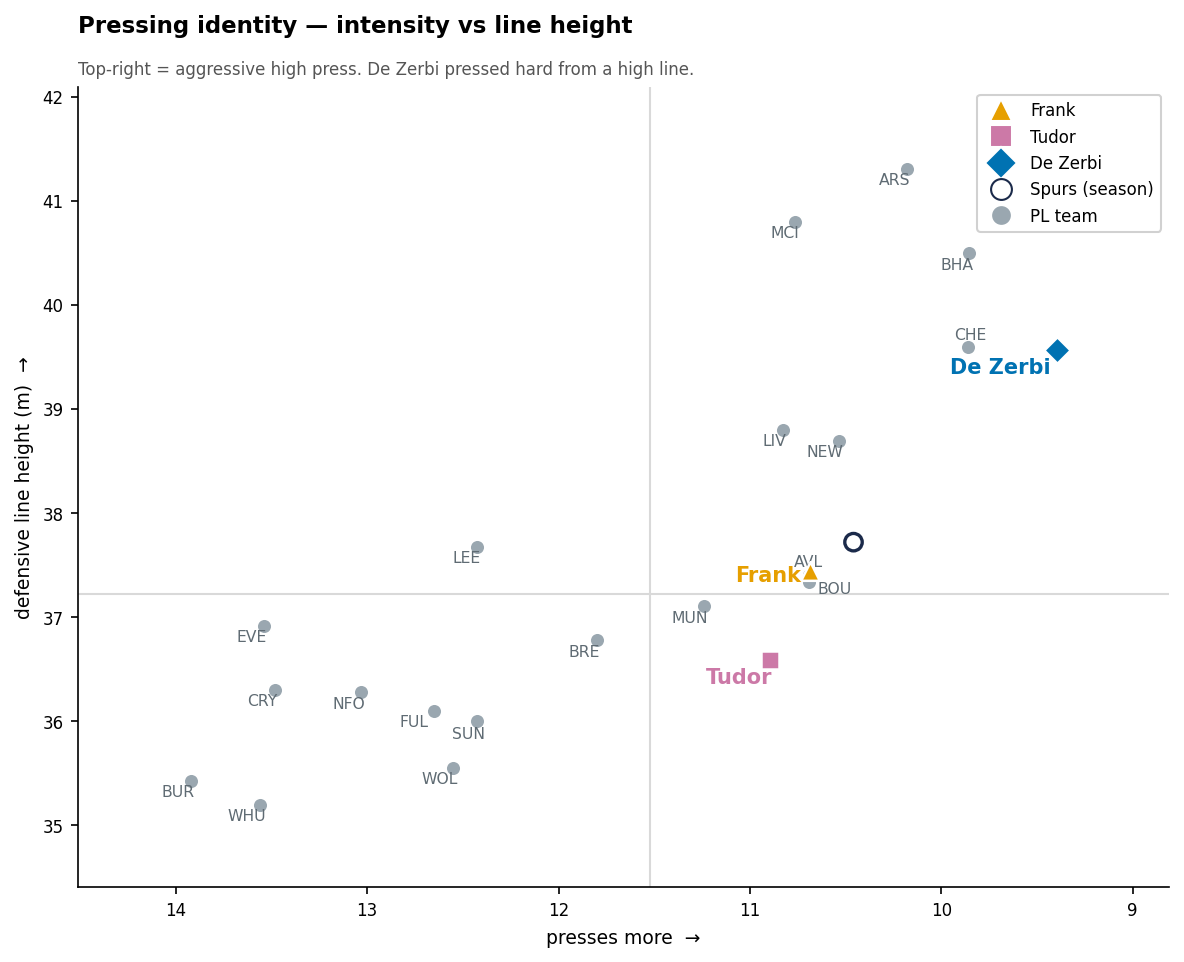
Here we are using PPDA (opposition passes allowed in the attacking 60% of the field per defensive action) to measure pressing. This captures how easy the opposition finds it to pass outside of the attacking part of the pitch, and is a good way to measure how intensely a team presses. A lower score means a more aggressive press.

De Zerbi scores a league best for PPDA, and his defensive line was high as well. Frank’s team were above average pressers, but his defensive line was around the mean.

Clearly once the Italian took charge, Spurs became an aggressive high pressing team.

Directness

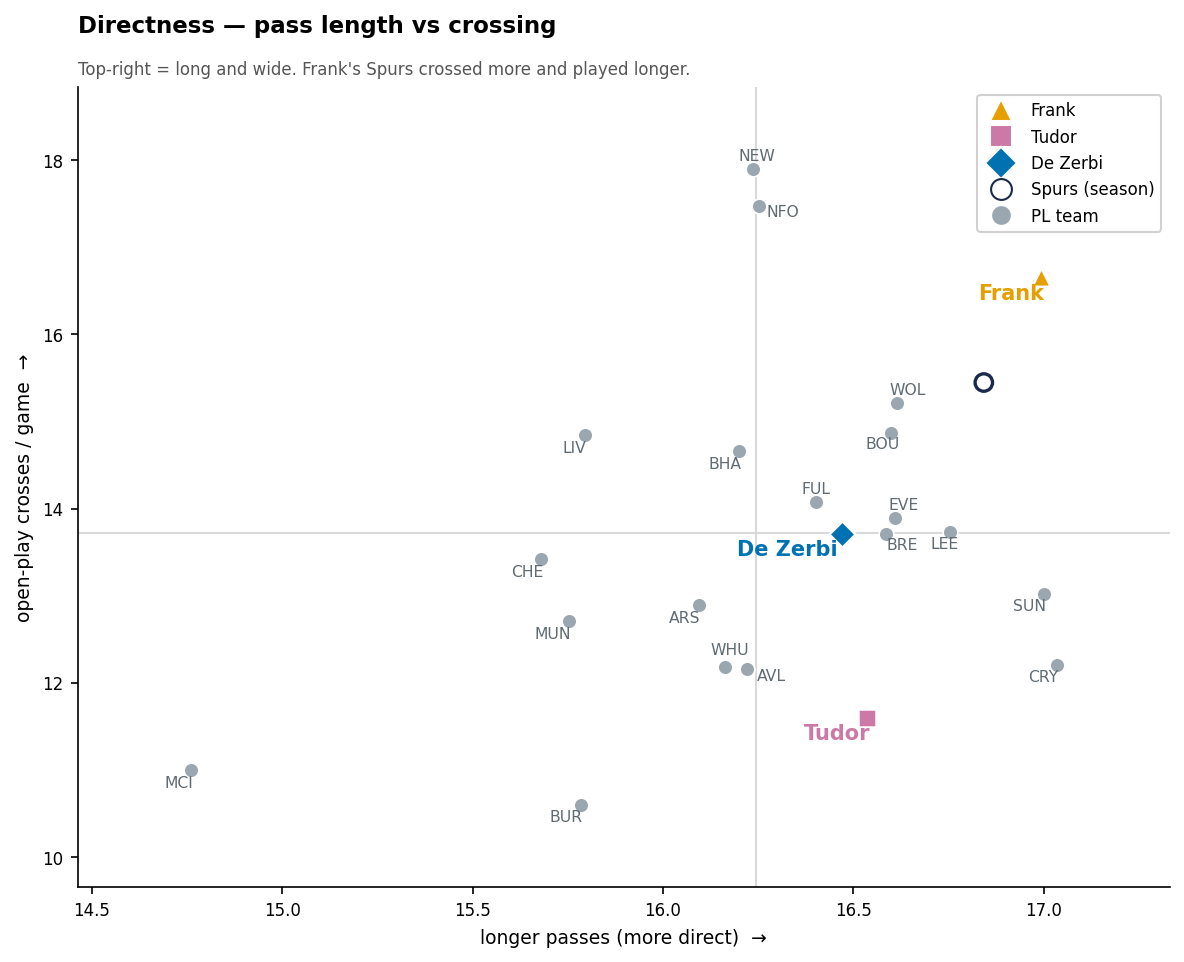
One thing that characterized Frank’s approach was a direct long ball strategy, and a lot of crosses. Whether this was intentional, or symptomatic of a lack ideas / quality on the ball is open to argument. The results aren’t.

Under De Zerbi we returned to the middle of the pack. Note how much of an outlier Pep’s Manchester City are here.

Possession

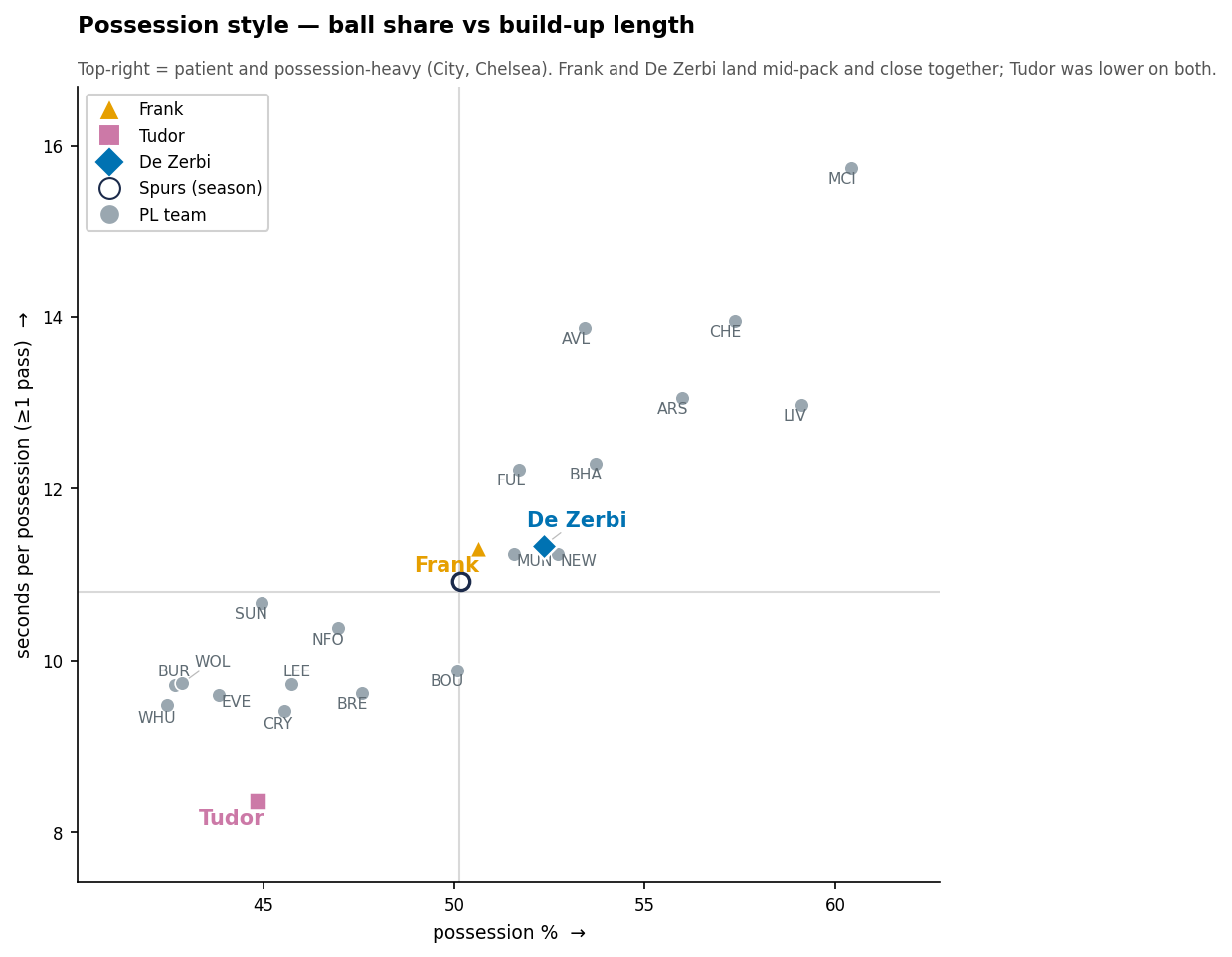
There wasn’t a massive uptick here, but De Zerbi’s team were a little more of a possession oriented side hopefully indicating the direction of travel. Frank was pretty much exactly average in this respect, although as an observer it often didn’t feel like it.

Manchester City are again massive outliers.

Conclusion

Thomas Frank’s team were failing full stop. It wasn’t just the results, the style of play was not likely to produce football that could challenge at the top of the division. His team created few shots, of low quality. Defensively they allowed the opposition high quality chances to score. Without the ball they pressed reasonably with a middling block, but with it they had average possession, and relied on long balls and crosses to create chances.

Roberto De Zerbi didn’t have the time or the personnel to make much change in the attacking output of the team, but he massively improved the defence. He did this through bravery, a high line and intensive press, rather than parking the bus. He also changed the style to be less reliant on long balls and crosses.

It will be really interesting to see how this will progress, given a transfer window and time to coach the team.

Spurs’ three managers head-to-head

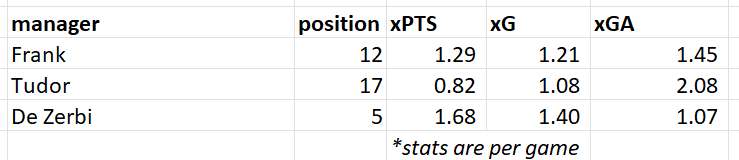
Spurs managed to make their way through three managerial appointments over the course of the 2025/2026 season. From turgid Thomas Frank ball, to Igor Tudor’s baffling reign, finally settling on saviour Roberto De Zerbi. Our eyes, and the results, told us that we finally ended up with the only competent candidate, but how do the top level stats look?

Note: I got the following from the excellent: https://understat.com/ which allows you to filter by dates.

Also Note: we don’t have great sample sizes, apart from for Frank, but it’s still interesting to compare.

Results

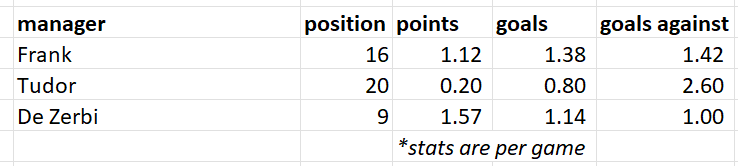
As expected De Zerbi’s record is the best. He makes it into the top half of the table during the his stint for the final seven games. Interestingly, it looks like this had more to do with a tightening up of the defence, rather than an increased scoring rate.

Expected goals

Goals are rare events, and as such, expected goals can often give a clearer picture of true form, especially when the sample size is small.

This matches more closely to my experience of watching these three versions of Tottenham. Tudor was the worst, but interestingly still not quite in the bottom three for the period he was in charge. Burnley, Wolves and Newcastle! had a worse expected points haul over those five games.

Frank was bad. Maybe not relegation bad, but the team were trending in that direction. The expected goals column makes more sense than the goals figure in the table above. On xG De Zerbi’s attack was more productive. Again it’s an even starker contrast for xGA (expected goals against). And Frank told us he was concentrating on building the defence first!

Conclusion

These number back up the general narrative among Spurs fans that Frank’s team was bad, Tudor’s team even worse, while De Zerbi had an immediate impact. Given that of the three, Frank was supposed to know the league, had time in preseason, two transfers windows, and (for at least part of the time) more fit players available to him, the numbers look particularly damning.

Do these stats back up the differences between the three managers? Are you happy we ended up with De Zerbi?

Why has it taken so long for Spurs attack to hit their stride?

Pochettino’s defence has been solid all season. Spurs have conceded a league low 14 goals; of the rest only Chelsea are below 20.

Going forward it’s not been as simple. Much like last season Spurs have struggled to break teams down in the early part of the campaign. And just like last time around, they’ve started to hit their stride mid-season. Spurs only scored 15 in their first 11 Premier League games, then 28 in the next 10.

So why is that?

  • Injuries to key players

The most obvious answer is the effect injuries have had on the squad. Last campaign Pochettino was very lucky, with the spine of the team available most weeks. That luck couldn’t hold forever and this season has seen long layoffs to several first team regulars – most notably Kane and Alderweireld.

The defence is more about a system, so it is easier to plug in new players, the attack is more about individuals and chemistry.

  • No European distractions

Our tendency to struggle in league games after midweek European trips is well documented, as is the boost teams get when they don’t have European football; see Chelsea and Liverpool this year. Our upturn in form has coincided with our exit from the Champions League. It’s not just less tiredness, it’s also the extra time on the training ground and the ability to focus.

  • A loss of form for some of our best performers

Last season so many of our players had stand out seasons. The anti-climax during the run in, plus a disappointing and tiring Euro’s for our England contingent, was always likely to leave its mark. Dembele and Eriksen have been notably below par and the Dane’s resurgence has been a key factor in our recent run.

  • A change of formation

Of late Pochettino has moved to three at the back and that has freed our most potent attacking threat, our fullbacks. They have provided the pace and width missing in the early part of the season, opening up space in the centre for Ali, Eriksen and Kane. Rose and Walker are possibly the best in the league, while Trippier and Davies have proved able deputies.

  • The nature of our attack

By it’s very nature Pochettino’s system relies on everyone being in sync. If one or two of our players are a little off the pace or not on the same wavelength it doesn’t work. The chemistry that sees Eriksen find Ali with a subtle flick, or Ali chip the ball to an onrushing Kane, takes time to get right. It’s operates on much finer margins than the defence.

  • Confidence

Even a casual 5-a-side player knows how important confidence is. One or two bad results and heads go down, the crowd gets restless, players take that second or two longer to make decisions, and worst of all, they take the safe option. There’s nothing like a run of wins and a happy crowd to fuel the kind of daring one touch attacking play we’ve seen of late. Long may it continue!

Why do you think Spurs have clicked? Do you think it will continue?  Please leave your thoughts in the comments section below.

Discuss it with me on Twitter: @ABPSpurs


Spurs’ title bid reinvigorated

SpursStoke4-0

As the Premier League season builds to a climax, Mauricio Pochettino’s Tottenham side are peaking at just the right time. It’s hard to remember two more impressive performances than the clinical way in which we dispatched Manchester United and Stoke City – two teams who certainly had the potential to derail our title push. Continue reading