Is Savinho the right target for Spurs?

Now that Spurs have added to their options in defence and central midfield, the next task is to refresh the attack. Last season, Spurs suffered from the loss of their two main contributors going forwards – James Maddison and Son Heung Min.

What we lost

As a winger Son added goal threat and chance creation.
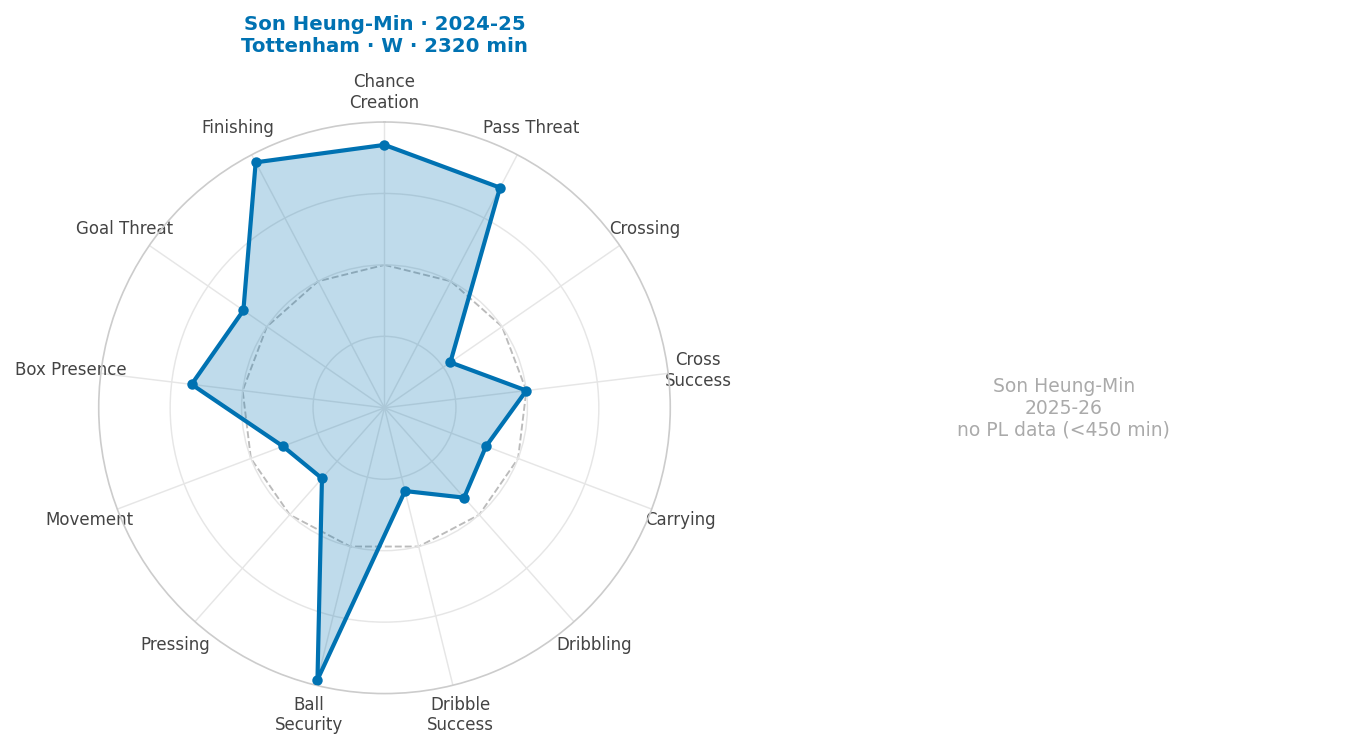
And backing him up in the number 10 position was Maddison, who suffered a season ending injury before his campaign had even begun.
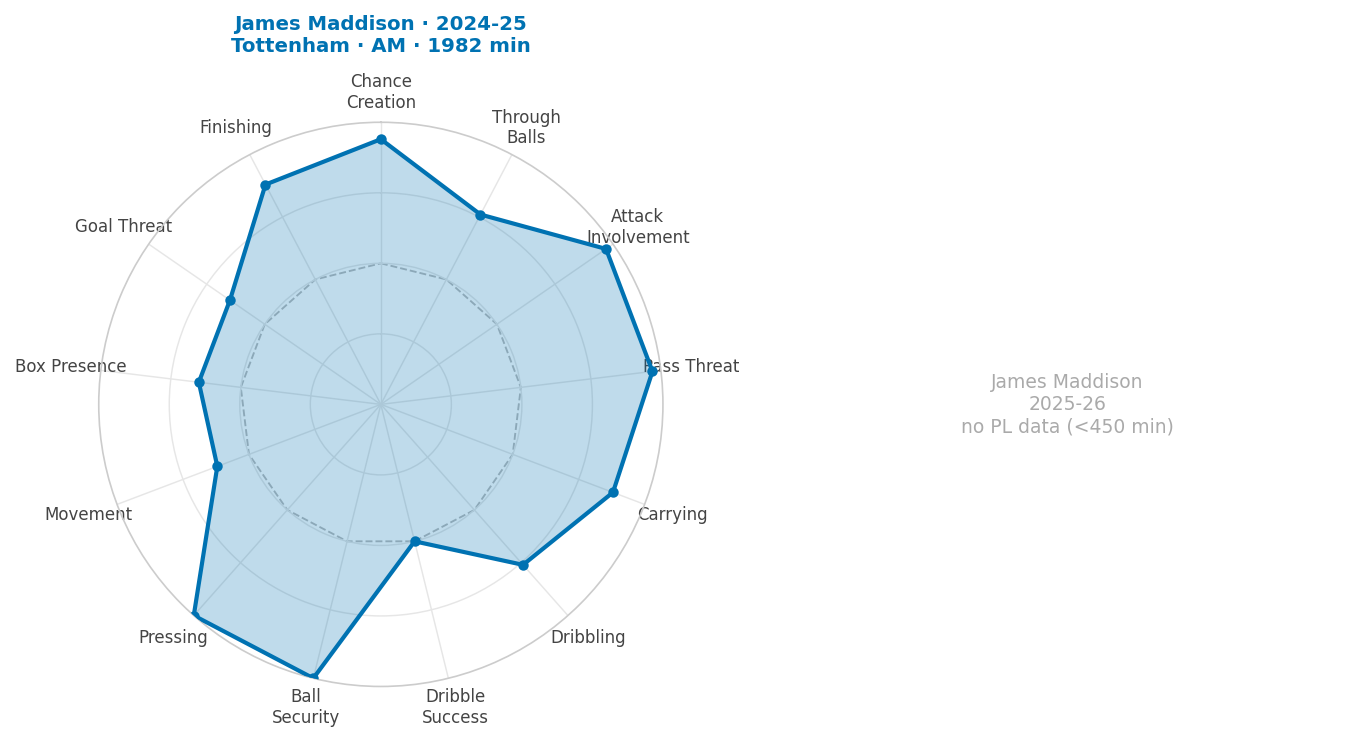
The Spurs midfielder has an amazingly balanced profile, contributing strongly in all areas, particularly creatively. Looking at his radar chart it’s not hard to see why Tottenham struggled to replace him.

What we have

Spurs were left with mainly young prospects like Odobert, Bergvall and Tel. It was always a tough ask.
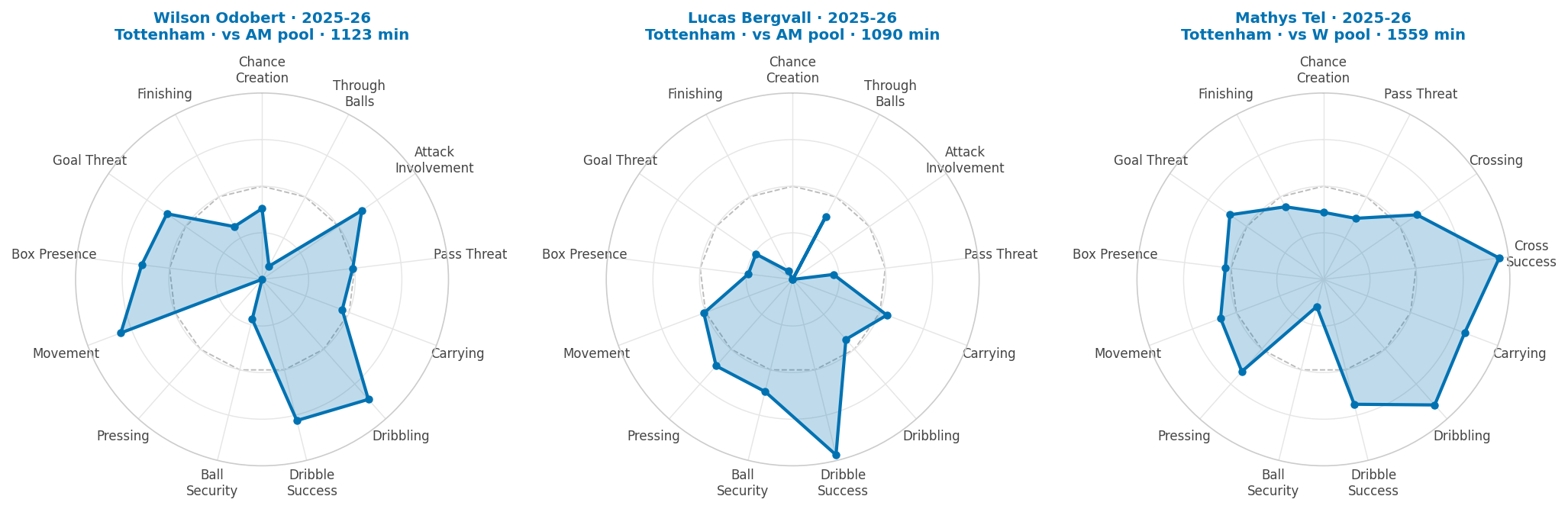
Odobert profiles as a transition carrier. He has high dribbling and goal threat but doesn’t contribute much to pressing or chance creation.

Bergvall is stuck somewhere between attacking midfield and a deeper role. His dribbling success hints at his potential, but he isn’t a Maddison replacement, with little contribution to creating or scoring goals.

Tel is the most impressive of the three, particularly when you compare his numbers with those from the previous campaign. He made huge strides forward, and looks like an option worth persevering with. However his output is still the issue, with mediocre chance creation and finishing.

The two best current candidates

Xavi Simons, who joined later in the season, is the nearest we have to a true number 10.
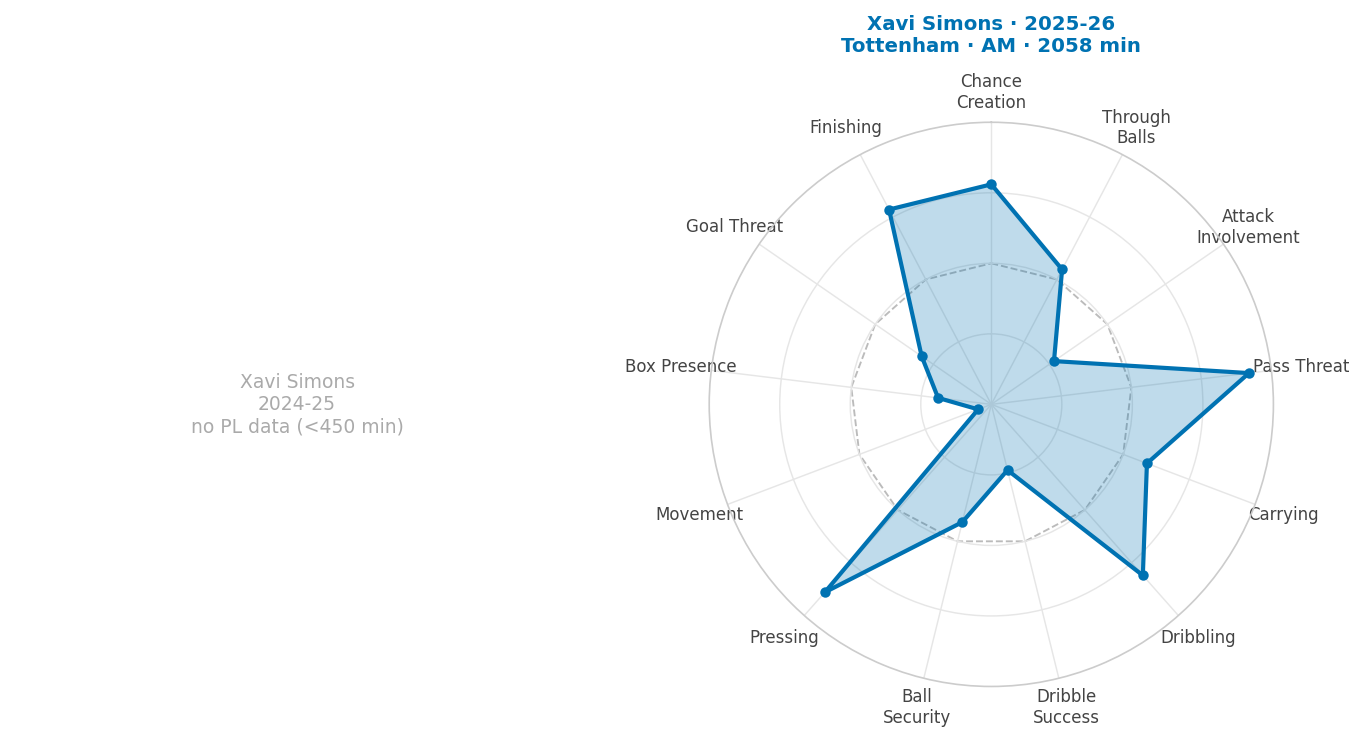
He’s strong in chance creation, and passing numbers, along with elite pressing but he’s missing a box presence. He prefers to do his work in deeper areas. After his unfortunate injury, he won’t be an option until later in the year.

Mohamed Kudus was one of the few bright spots last season.
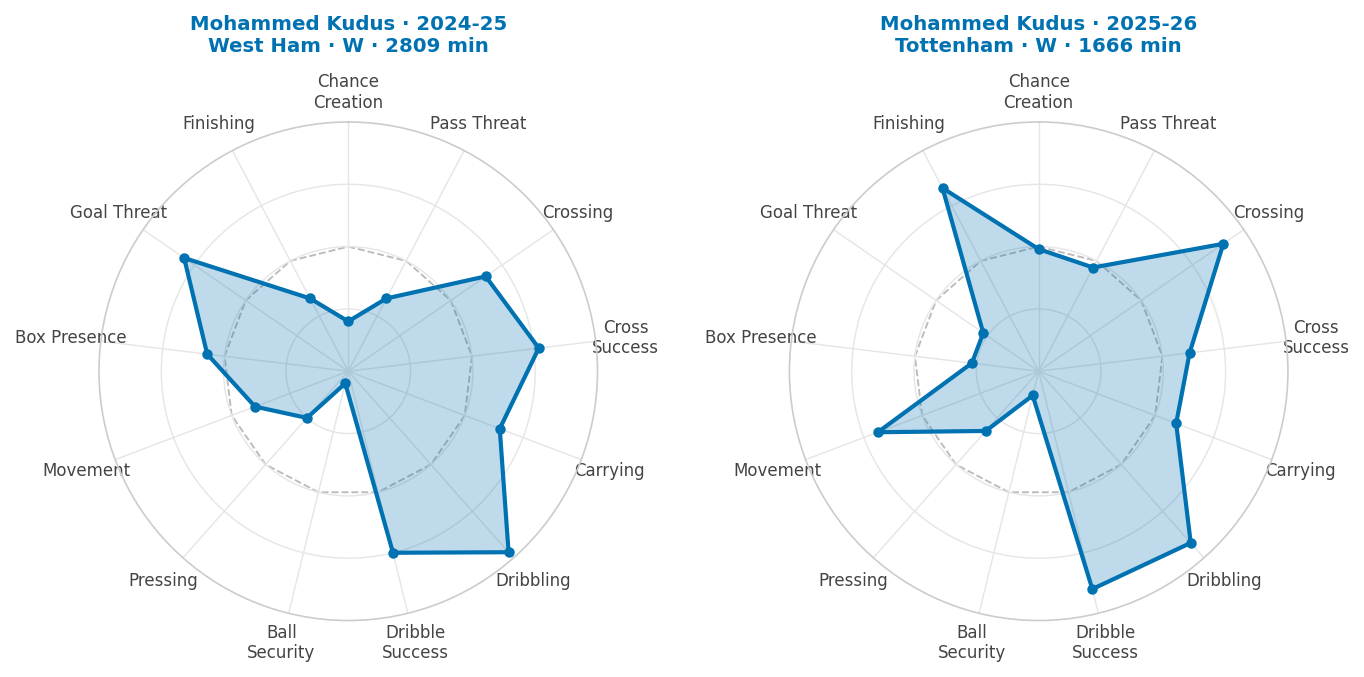
He is a top tier dribbler, and his carrying and crossing is also good. The problem is the end product, with little in the way of goal threat and only average chance creation. He is also one of the most turnover-prone players in the league. He takes risks, and that has a cost.

Of course last year Frank put him in unfavourable positions and asked him to work miracles. We have yet to see him in De Zerbi’s system, and there is hope for improvement in a tactical setup that should be more suited to getting wingers in good attacking areas.

Number 10 or winger?

if we are looking for a number 10, Morgan Gibbs-White is an obvious shout. He added more goal threat to his game last season, so would be a good complementary alternative to Xavi. However, given we have Maddison back, and hopefully Xavi will be also be an option later in the year, left wing is the most pressing position to fill.

Other options on the wing include Yakuba Minteh (he’s more right sided and similar to Kudus) or Kevin (he profiles almost identically to Tel).

Savinho

Savinho was heavily linked to Spurs last transfer window, and the rumours are even stronger this summer. But is he the right fit?

If we look at his 2025/26 numbers it appears not. But his season was affected by injury, being used out of position, and finding himself behind new Manchester City addition Jeremy Doku, a league standout.
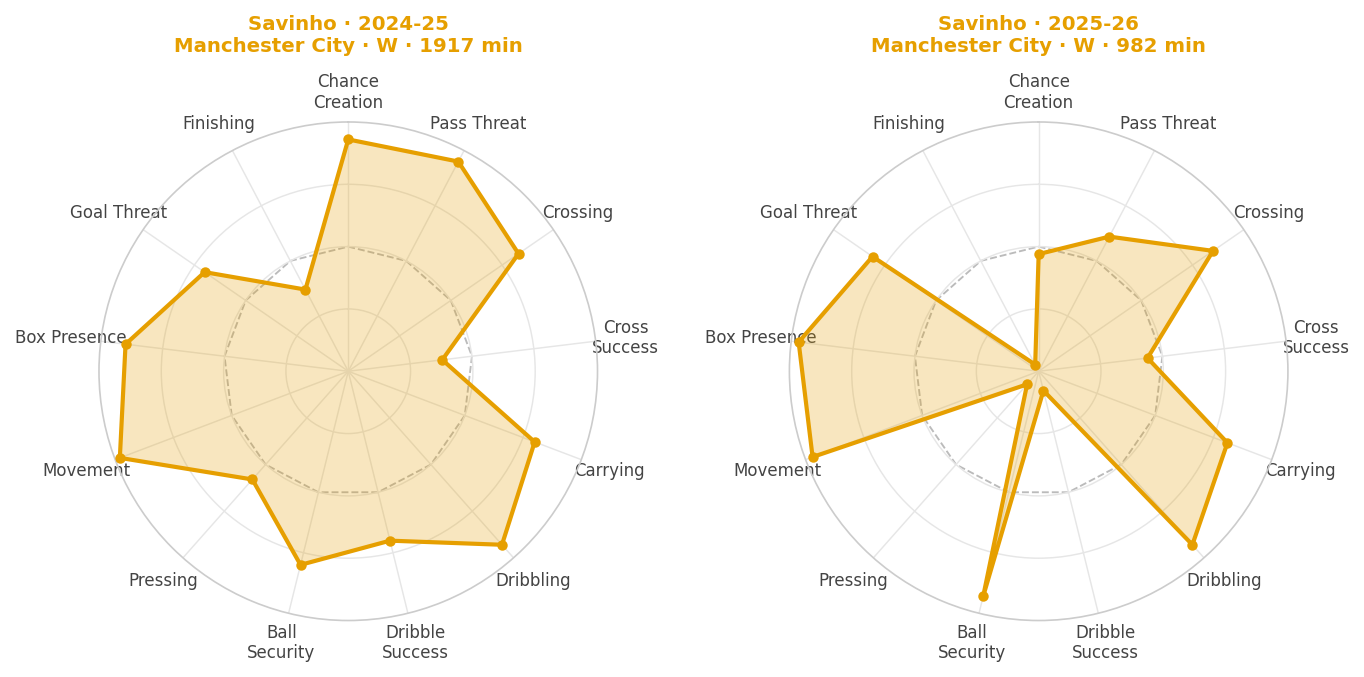
If we instead look back at the previous year the picture is a lot rosier. He’s the closest match I could find from current Premier League players to the missing profile. He’s in the 93rd percentile for chance creation, 95th for pass threat, 98th for movement, 90th for box presence, all combined with 93rd-percentile dribbling with much higher ball security than Kudus.

His finishing maybe leaves a little to be desired but overall he looks like a great option. The risk is can he recapture this form?

In my mind there are sufficient mitigating factors to explain last season’s drop off. Of course this drop off is one reason Manchester City are willing to sell, and why the price is not completely crazy.

So what should Spurs do?

For me it’s not even close, Savinho is a gamble worth taking and Spurs should do what it takes to bring the Brazilian to the Tottenham Stadium.

Note: My analysis is limited to Premier League players. It may well be that we can find better, cheaper options elsewhere, but Spurs do seem to have focused their new recruitment strategy on the English top flight.

Do you think Savinho is a good transfer target for Spurs?

Why have Spurs spent so much on Tonali and Fernandes?

Spurs have surprisingly been the big movers in this summer’s market, smashing their transfer record to bring in Mateus Fernandes and Sandro Tonali for a combined value just shy of £200M.

This uncharacteristically decisive action appears driven by the shock of last season’s close call with relegation, and as a reward for manager Roberto De Zerbi for saving the club from dropping into the second tier.

But why have they broken the bank to bring in two central midfield options, especially given the number of midfield players already at the club?

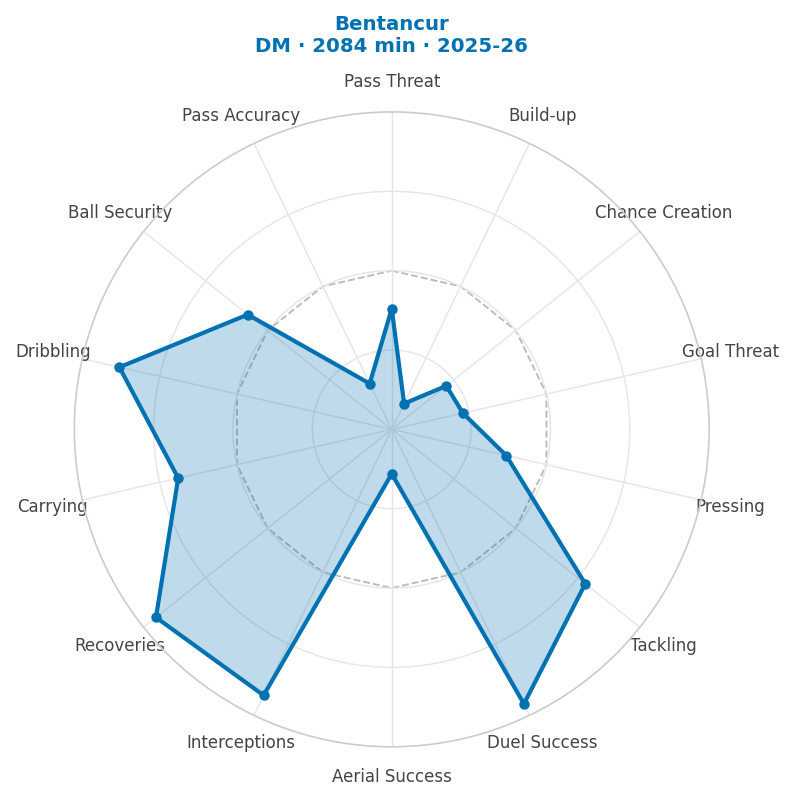
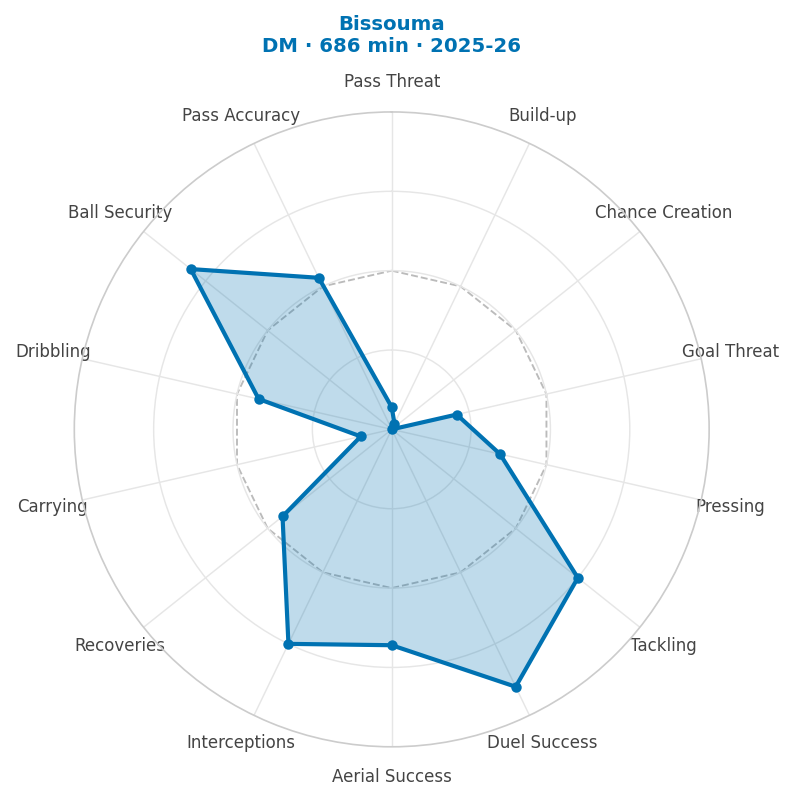
Let’s look at some radar charts from last season for Spurs players who played in a deeper, central midfield / pivot role.

Palhinha

As you would expect, Palhinha was very strong defensively – his tackling, duels and aerial battles are all very impressive. He was also good at carrying the ball, and provided a surprising amount of goal threat, which makes sense given his vital goal contributions in last season’s run in. However it’s fair to say that passing and creativity are not his strengths.

Bentancur

Bentancur showed similar ball winning abilities but without the aerial dominance or goal threat. Carrying was a positive for him too, and he also impressed with his press resistance – dribbling opponents and rarely losing possession. However, he also lacked in creative passing and contribution to build up play.

Bissouma

Bissouma didn’t get that many minutes, but when he did play he showed similar battling qualities to Palhinha, but with more care in possession. His passing was accurate, but these were mainly simple passes. He didn’t create much or even move the ball forward.

The Rest

Sarr, Gallagher, Gray and Bergvall aren’t really suited to the deep lying pivot role. Gallagher and Bergvall have very similar profiles – massively strong at carrying / dribbling and also at pressing. Sarr is relatively rounded but his talents lie further up the pitch – his pressing and goal threat stand out. Gray has played in so many roles it’s hard to analyse him.

The Missing Profile

So it’s pretty clear where Spurs were lacking last year – creative passing and build up play from deep areas. Part of that was dictated by the negative playing style of Thomas Frank, but it’s clearly also a skillset lacking in the squad.

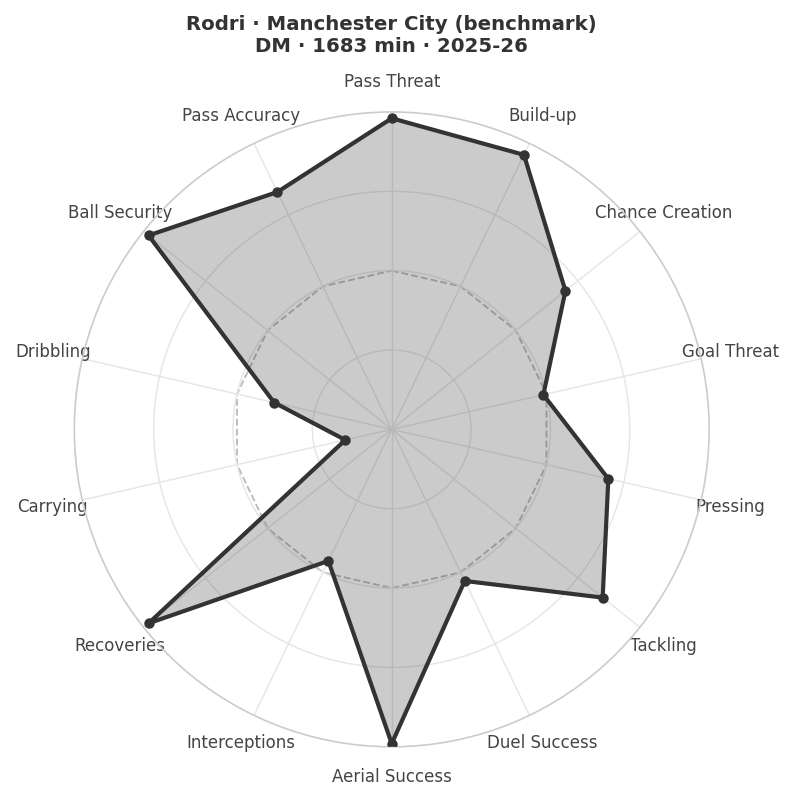
An example of the kind of player who fits this profile perfectly is Rodri, the standout in recent Premier league history.

Rodri

And here’s new Manchester City recruit Elliot Anderson.

Anderson

They both still have ball winning attributes, but they also participate in build up play and move the ball forward through their passing. They are actually very similar, except that Rodri is more careful in possession while Anderson is more of a threat through his dribbling. Given the fact he played for a relegation threatened team who went through multiple managers with differing styles, Anderson’s performances are really impressive.

Spurs Signings

So how do Tottenham’s new signings stack up?

Fernandes

Mateus Fernandes is a massive improvement on our current options. He is more of an all rounder, marrying defensive strengths, with dribbling and the all important passing ability and creativity. His numbers are not as high as Rodri or Anderson, but he’s young and he spent the season playing for West Ham, under Nuno Espirito Santo for a large part of it, which can’t have been easy.

Tonali

At first glance Tonali seems a bit disappointing on the defensive side of the ball. But looking closer he’s more positionally smart, picking up interceptions and ball recoveries, rather than the blood and thunder tackling of Palhinha. He’s also relatively press resistant with strong showings in carrying and dribbling, married with ball security. His attacking threat both from carrying and passing looks pretty good too. Maybe not exactly £100 million worth, but he’s still a big upgrade.

Summary

Of course the statistics never show the full picture, but it looks like we have bought two players that materially improve our squad in one of its weakest areas. Arguably we have paid a lot and not got the absolute best, but given our low starting point after a brush with relegation, I think we have made some intelligent moves. It will be exciting to see how both players perform once the season gets under way.

What do you think of Spurs midfield signings? Are they an upgrade or a waste of money?

Frank vs De Zerbi – a deeper dive

In my last post I looked at some statistics that demonstrated how the performances at Spurs improved when we swapped the turgid football of Thomas Frank for the sunlit uplands of De Zerbi-ball. Continuing this theme, I thought I’d use some more advanced metrics to take a deeper dive into their contrasting styles, with the help of the wealth of data available online, and a copy of Claude Code.

Caveat: There is one big problem that makes this exercise interesting but not particularly scientific. Whilst we have a relatively large sample size for Frank, we have just seven games for De Zerbi, against arguably a relatively easy set of opponents. I still think it’s interesting to crunch the numbers but take them with a pinch of salt.

Caveat 2: I used data scraped from the various sites on the internet and built my own models using Claude Code. Therefore my models and data may not 100% align with others, although they do seem pretty close and I have carefully cross checked the logic / data.

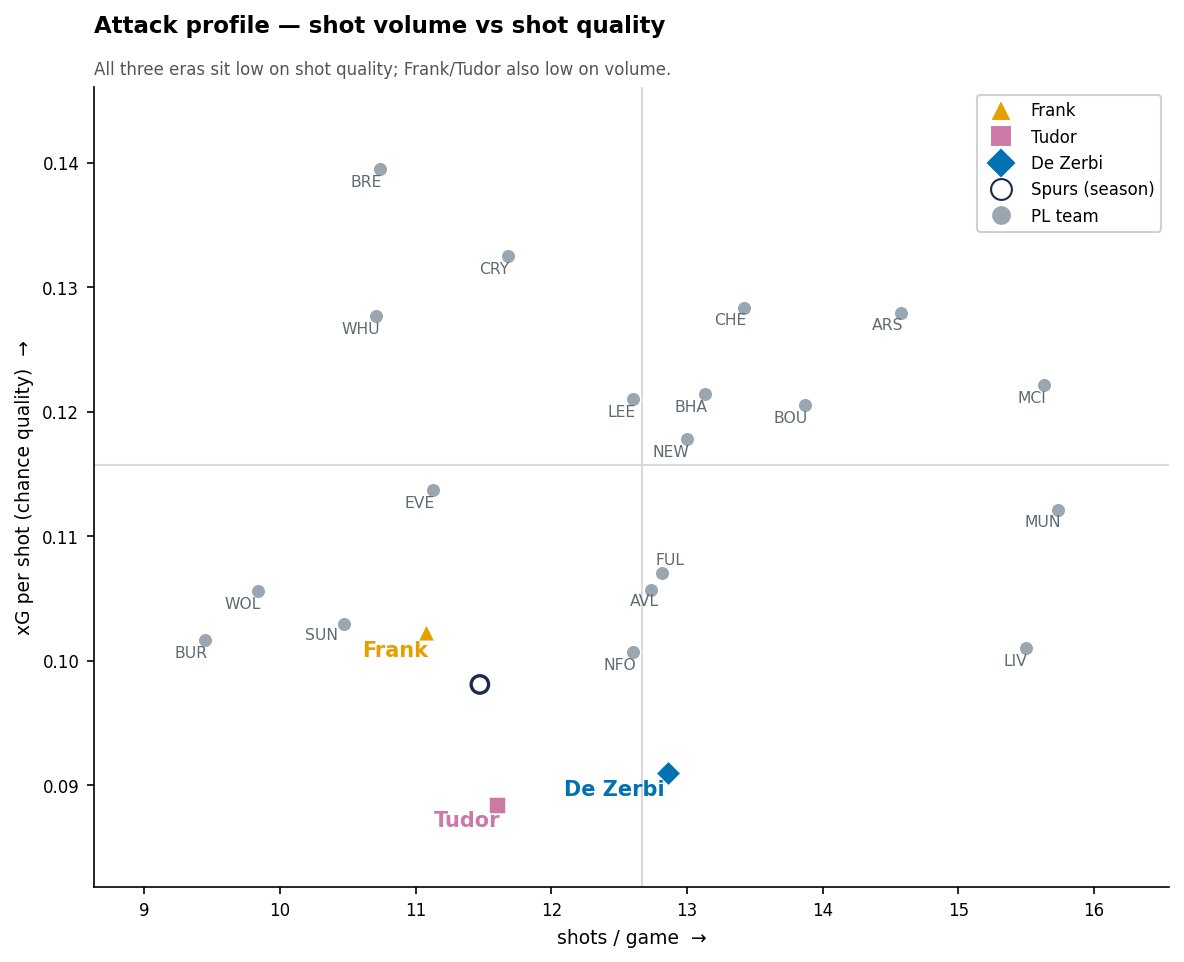
Note: the graphs are presented with positive metrics being up and to the right, this sometimes means the numbers on the axes are reversed.

Attacking

De Zerbi is most known for his team’s style when they have possession. It’s interesting that while shot volume increased to above the league average, shot quality actually decreased to worse than any individual team. It wasn’t an improvement in our attack that kept Tottenham up.

Given the little time available to the Italian, and the lack of a transfer window, this isn’t that surprising.

Defending

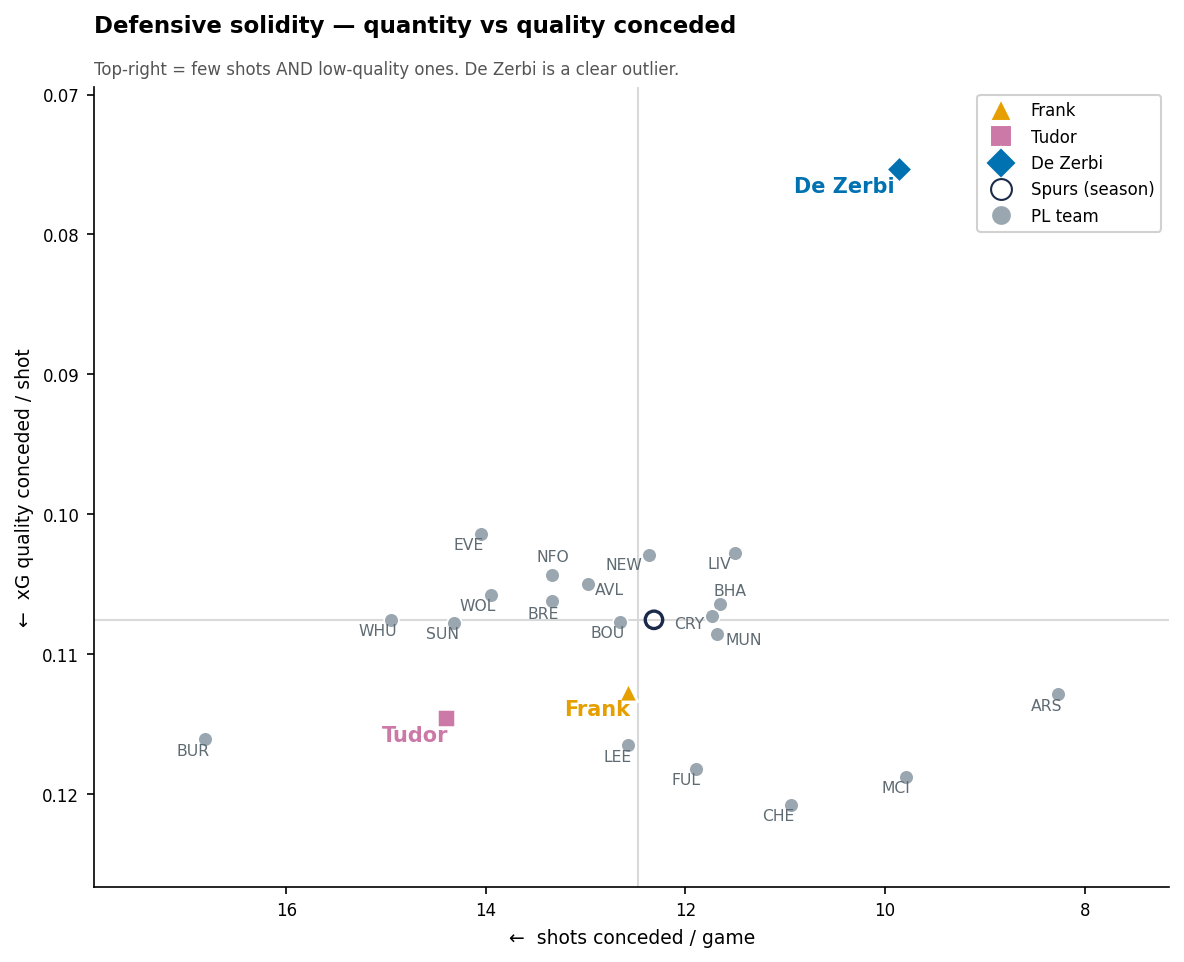
It was actually the defensive side of the ball that saw the most impact from the change of coach, and what an impact. Both the opposition’s shot volume, and the quality of those chance fell dramatically, to the extent that De Zerbi’s time in charge is a massive outlier. This is probably exaggerated by the small sample size, the context of a relegation battle, and the difficulty of the opponents faced. Even given those caveats, this seems a strong enough signal that something fundamental had changed.

Frank conceded around average shot volumes, but the chances conceded were above average opportunities to score. It’s interesting to see league leaders Arsenal and Manchester City gave up similarly high quality chances, but also noticeable that these were in much lower volumes.

Pressing and Winning The Ball

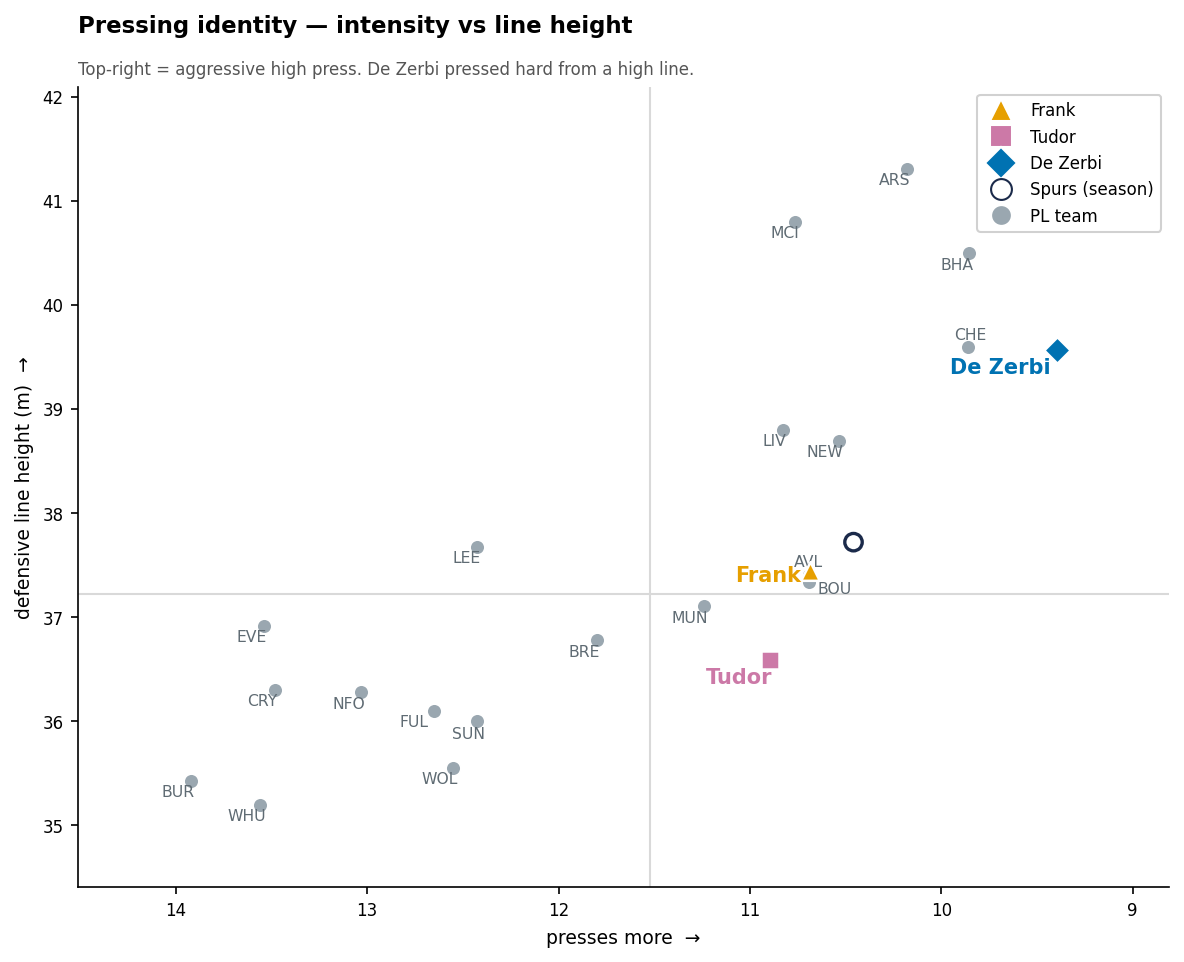
Here we are using PPDA (opposition passes allowed in the attacking 60% of the field per defensive action) to measure pressing. This captures how easy the opposition finds it to pass outside of the attacking part of the pitch, and is a good way to measure how intensely a team presses. A lower score means a more aggressive press.

De Zerbi scores a league best for PPDA, and his defensive line was high as well. Frank’s team were above average pressers, but his defensive line was around the mean.

Clearly once the Italian took charge, Spurs became an aggressive high pressing team.

Directness

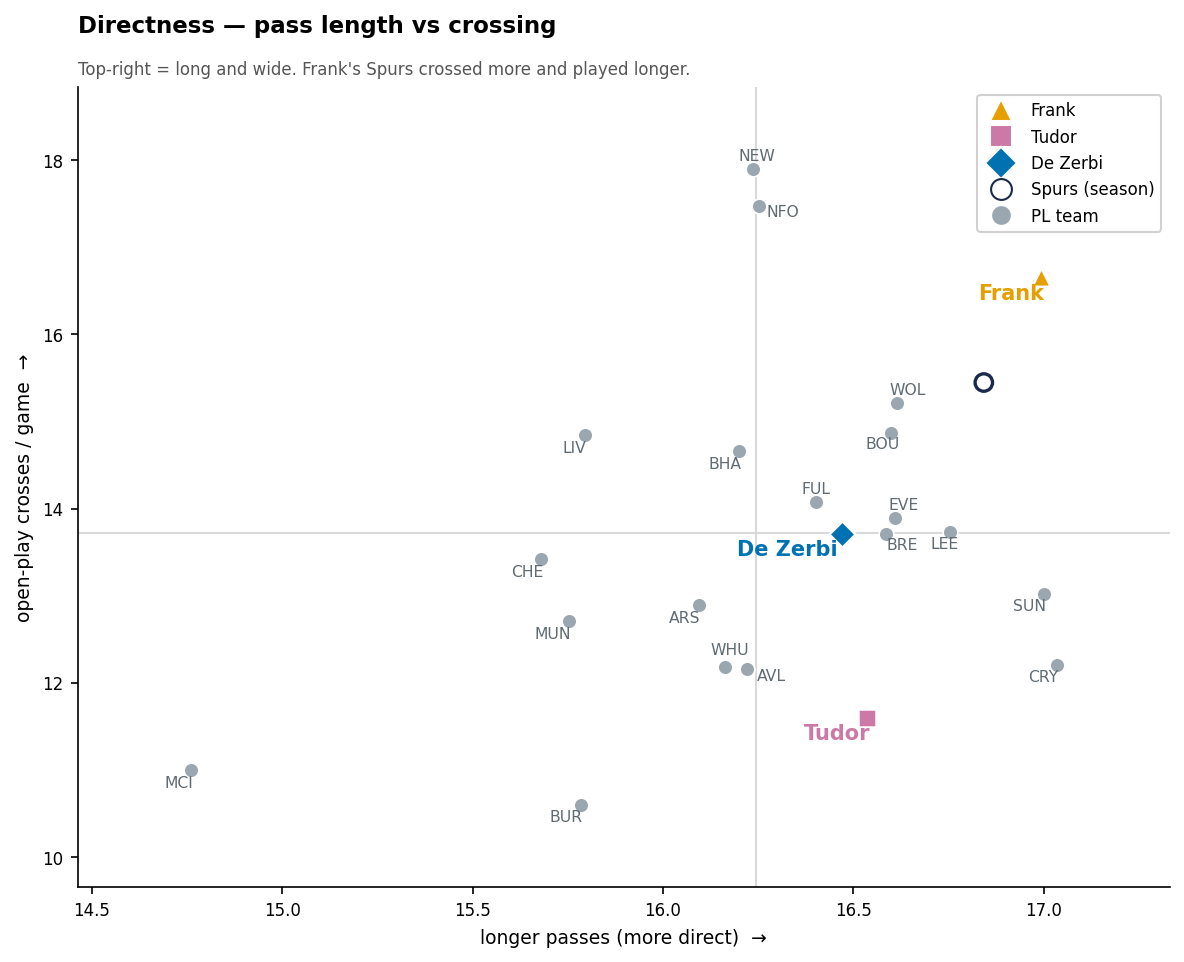
One thing that characterized Frank’s approach was a direct long ball strategy, and a lot of crosses. Whether this was intentional, or symptomatic of a lack ideas / quality on the ball is open to argument. The results aren’t.

Under De Zerbi we returned to the middle of the pack. Note how much of an outlier Pep’s Manchester City are here.

Possession

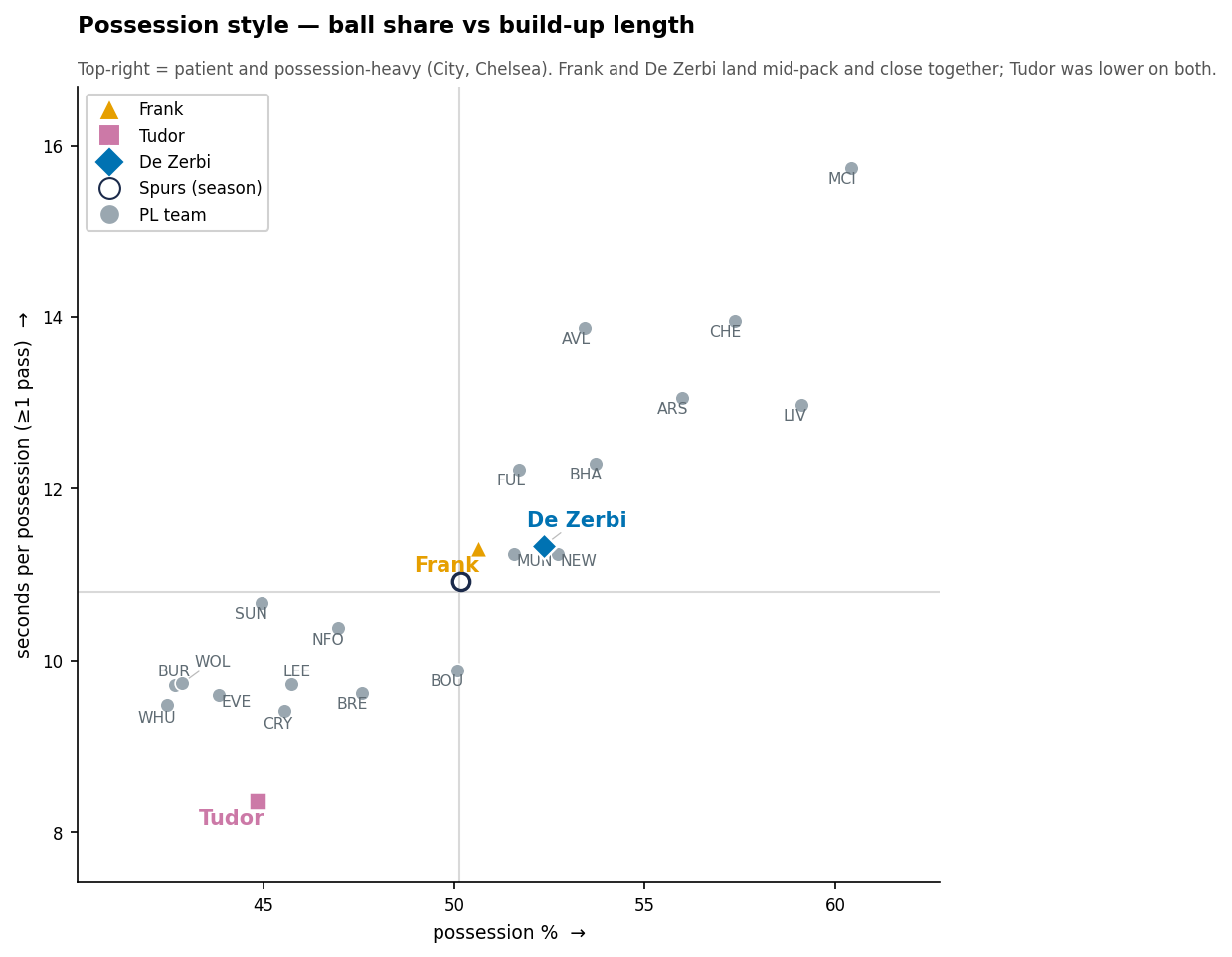
There wasn’t a massive uptick here, but De Zerbi’s team were a little more of a possession oriented side hopefully indicating the direction of travel. Frank was pretty much exactly average in this respect, although as an observer it often didn’t feel like it.

Manchester City are again massive outliers.

Conclusion

Thomas Frank’s team were failing full stop. It wasn’t just the results, the style of play was not likely to produce football that could challenge at the top of the division. His team created few shots, of low quality. Defensively they allowed the opposition high quality chances to score. Without the ball they pressed reasonably with a middling block, but with it they had average possession, and relied on long balls and crosses to create chances.

Roberto De Zerbi didn’t have the time or the personnel to make much change in the attacking output of the team, but he massively improved the defence. He did this through bravery, a high line and intensive press, rather than parking the bus. He also changed the style to be less reliant on long balls and crosses.

It will be really interesting to see how this will progress, given a transfer window and time to coach the team.

Spurs’ three managers head-to-head

Spurs managed to make their way through three managerial appointments over the course of the 2025/2026 season. From turgid Thomas Frank ball, to Igor Tudor’s baffling reign, finally settling on saviour Roberto De Zerbi. Our eyes, and the results, told us that we finally ended up with the only competent candidate, but how do the top level stats look?

Note: I got the following from the excellent: https://understat.com/ which allows you to filter by dates.

Also Note: we don’t have great sample sizes, apart from for Frank, but it’s still interesting to compare.

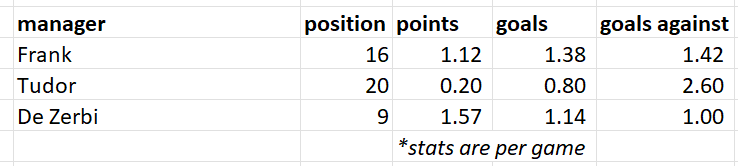
Results

As expected De Zerbi’s record is the best. He makes it into the top half of the table during the his stint for the final seven games. Interestingly, it looks like this had more to do with a tightening up of the defence, rather than an increased scoring rate.

Expected goals

Goals are rare events, and as such, expected goals can often give a clearer picture of true form, especially when the sample size is small.

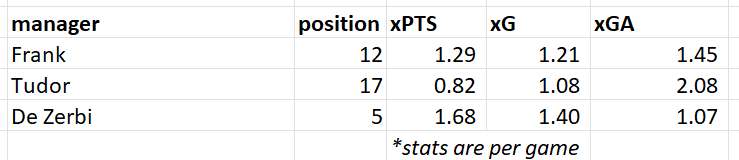
This matches more closely to my experience of watching these three versions of Tottenham. Tudor was the worst, but interestingly still not quite in the bottom three for the period he was in charge. Burnley, Wolves and Newcastle! had a worse expected points haul over those five games.

Frank was bad. Maybe not relegation bad, but the team were trending in that direction. The expected goals column makes more sense than the goals figure in the table above. On xG De Zerbi’s attack was more productive. Again it’s an even starker contrast for xGA (expected goals against). And Frank told us he was concentrating on building the defence first!

Conclusion

These number back up the general narrative among Spurs fans that Frank’s team was bad, Tudor’s team even worse, while De Zerbi had an immediate impact. Given that of the three, Frank was supposed to know the league, had time in preseason, two transfers windows, and (for at least part of the time) more fit players available to him, the numbers look particularly damning.

Do these stats back up the differences between the three managers? Are you happy we ended up with De Zerbi?

Spurs just about survived, now who should stay and who should go?

And breath. Finally Spurs are safe from the threat of relegation after making supporters sweat until the final moments of the final game. It feels so cathartic, especially as everything now resets. We begin next season level with everyone else. It almost feels like cheating.

Big changes are clearly necessary, but who should stay and who should go?

The Board

Spurs problems begins at the top. Vinai Venkatesham should be the first to fall on his sword. The amateurish decisions, from the failure to take the initiative when Frank was clearly not performing, to the Tudor debacle, were a lesson in how not to run a football club. Vinai has to go.

Recruitment

Second out the door should be Lange. While we have recruited some promising young players, squad building has been appalling. The balance of the team from the overindexing on youthful potential, to the lack of balance in midfield has shown a lack of high level planning. The fact that we failed to address these problems in January, in the middle of an injury crisis was at best negligent. He is a good scout, not a director of football.

Players

We clearly need more technical ability, especially in midfield. Despite the return of James Maddison, we need younger creative midfielders, to replace the surplass of hard working box-to-box players.

Depending on who we can sign and who the manager feels fits his system, we will clearly need wholesale changes. This is as much about balance as any individual but I would definitely look to move on:

  • Dragusin – zero technical ability, why did we sign him?
  • Bissouma – checked out a while ago.
  • Muani – showed nothing on loan, and was replaced by a defender in the final game.
  • Palhinha – full of effort and scored some key goals but his lack of technical ability will hold us back.
  • Richarlison – still scores goals, but the injuries have taken a toll.
  • Sarr – we just have too many similar midfielders.
  • Vicario – Kinsky’s excellent end of season performances showed up the Italian’s flaws with the ball and at crosses.

On top of this It remains to be seen what happens to our two starting centre backs, we need a backup to Kudus, a reliable starter up front, and we need to swap one or two more of our midfield options for different profiles.

Despite all this, I think we have the key appointment right. Roberto De Zerbi’s impact saved us from relegation. I think he has the personality and philosophy to turn Spurs around, he has certainly earned the right to try.

Who do you think should stay and who should be immediately shown the door?

Please Daniel Levy, do whatever it takes…

It’s quite a while since I have posted here, but the current crisis at Spurs has moved me to put pen to paper (well metaphorically speaking). It feels like this could be a key point in Tottenham’s future, a moment where two very different timelines diverge.

In one timeline, Levy appoints Antonio Conte, or more probably a lesser equivalent. Maybe this will work in the short term and it should certainly be a lot more fun than life under Nuno. But it feels like another vanity choice, not so dissimilar from his obsession to appoint Mourinho, if very different in footballing style.

Continue reading