Tag Archives: Statistics

Why have Spurs spent so much on Tonali and Fernandes?

Spurs have surprisingly been the big movers in this summer’s market, smashing their transfer record to bring in Mateus Fernandes and Sandro Tonali for a combined value just shy of £200M.

This uncharacteristically decisive action appears driven by the shock of last season’s close call with relegation, and as a reward for manager Roberto De Zerbi for saving the club from dropping into the second tier.

But why have they broken the bank to bring in two central midfield options, especially given the number of midfield players already at the club?

Let’s look at some radar charts from last season for Spurs players who played in a deeper, central midfield / pivot role.

Palhinha

As you would expect, Palhinha was very strong defensively – his tackling, duels and aerial battles are all very impressive. He was also good at carrying the ball, and provided a surprising amount of goal threat, which makes sense given his vital goal contributions in last season’s run in. However it’s fair to say that passing and creativity are not his strengths.

Bentancur
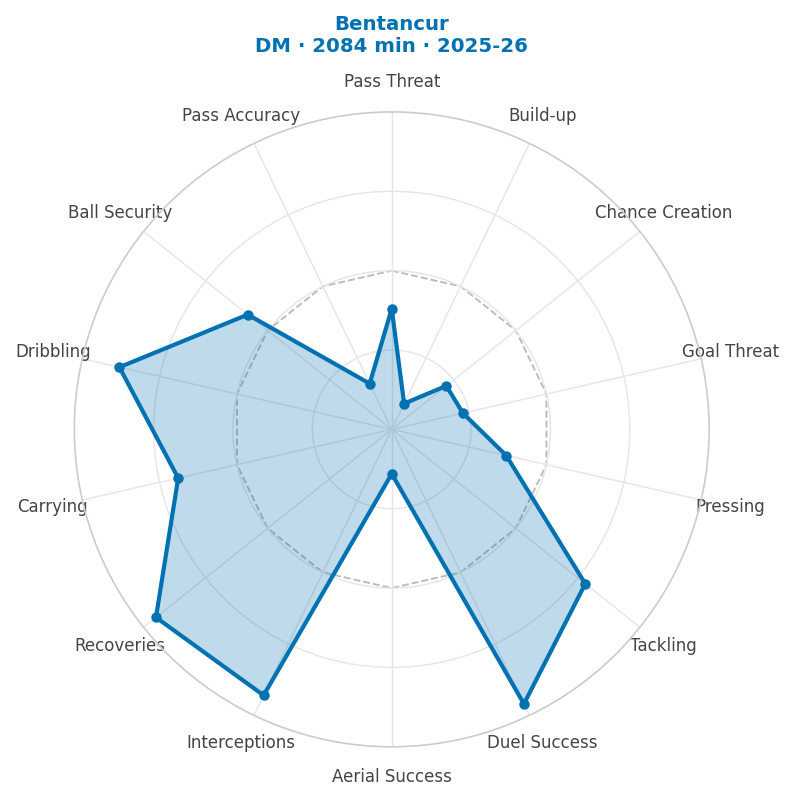
Bentancur showed similar ball winning abilities but without the aerial dominance or goal threat. Carrying was a positive for him too, and he also impressed with his press resistance – dribbling opponents and rarely losing possession. However, he also lacked in creative passing and contribution to build up play.

Bissouma
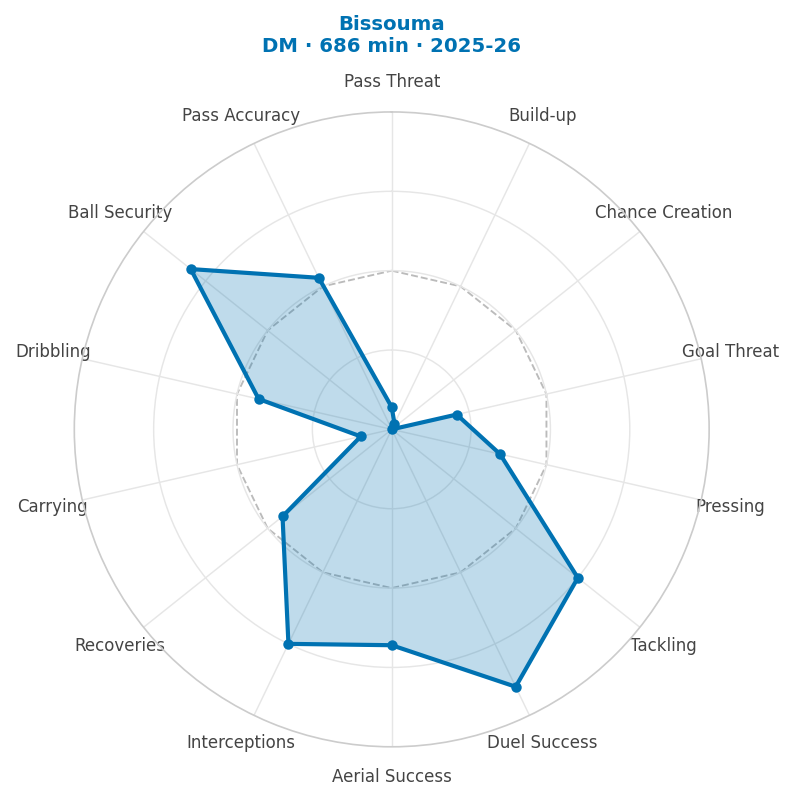
Bissouma didn’t get that many minutes, but when he did play he showed similar battling qualities to Palhinha, but with more care in possession. His passing was accurate, but these were mainly simple passes. He didn’t create much or even move the ball forward.

The Rest

Sarr, Gallagher, Gray and Bergvall aren’t really suited to the deep lying pivot role. Gallagher and Bergvall have very similar profiles – massively strong at carrying / dribbling and also at pressing. Sarr is relatively rounded but his talents lie further up the pitch – his pressing and goal threat stand out. Gray has played in so many roles it’s hard to analyse him.

The Missing Profile

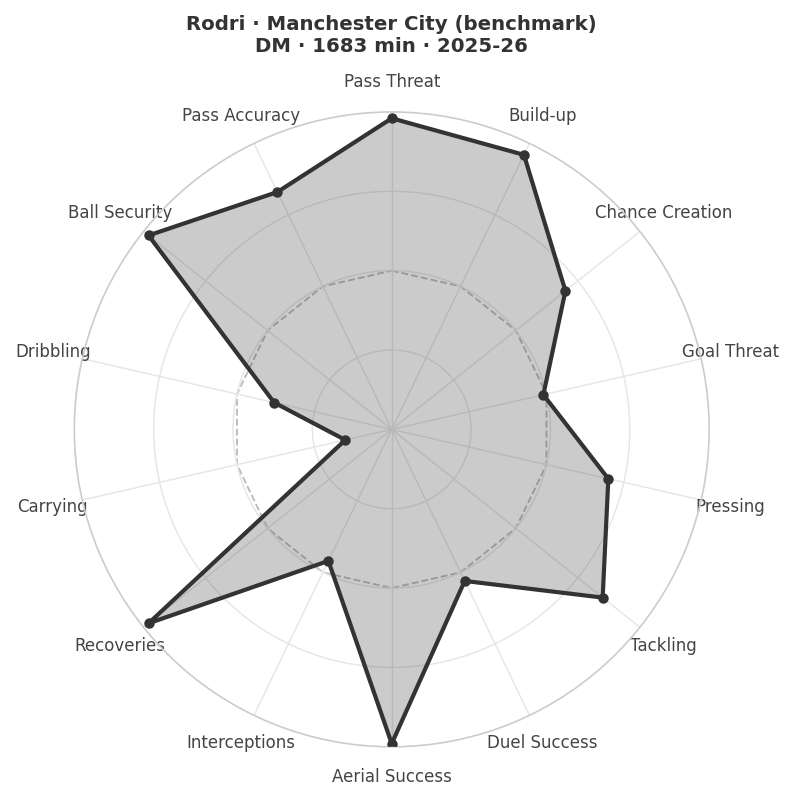
So it’s pretty clear where Spurs were lacking last year – creative passing and build up play from deep areas. Part of that was dictated by the negative playing style of Thomas Frank, but it’s clearly also a skillset lacking in the squad.

An example of the kind of player who fits this profile perfectly is Rodri, the standout in recent Premier league history.

Rodri
And here’s new Manchester City recruit Elliot Anderson.

Anderson

They both still have ball winning attributes, but they also participate in build up play and move the ball forward through their passing. They are actually very similar, except that Rodri is more careful in possession while Anderson is more of a threat through his dribbling. Given the fact he played for a relegation threatened team who went through multiple managers with differing styles, Anderson’s performances are really impressive.

Spurs Signings

So how do Tottenham’s new signings stack up?

Fernandes

Mateus Fernandes is a massive improvement on our current options. He is more of an all rounder, marrying defensive strengths, with dribbling and the all important passing ability and creativity. His numbers are not as high as Rodri or Anderson, but he’s young and he spent the season playing for West Ham, under Nuno Espirito Santo for a large part of it, which can’t have been easy.

Tonali

At first glance Tonali seems a bit disappointing on the defensive side of the ball. But looking closer he’s more positionally smart, picking up interceptions and ball recoveries, rather than the blood and thunder tackling of Palhinha. He’s also relatively press resistant with strong showings in carrying and dribbling, married with ball security. His attacking threat both from carrying and passing looks pretty good too. Maybe not exactly £100 million worth, but he’s still a big upgrade.

Summary

Of course the statistics never show the full picture, but it looks like we have bought two players that materially improve our squad in one of its weakest areas. Arguably we have paid a lot and not got the absolute best, but given our low starting point after a brush with relegation, I think we have made some intelligent moves. It will be exciting to see how both players perform once the season gets under way.

What do you think of Spurs midfield signings? Are they an upgrade or a waste of money?
Frank vs De Zerbi – a deeper dive

In my last post I looked at some statistics that demonstrated how the performances at Spurs improved when we swapped the turgid football of Thomas Frank for the sunlit uplands of De Zerbi-ball. Continuing this theme, I thought I’d use some more advanced metrics to take a deeper dive into their contrasting styles, with the help of the wealth of data available online, and a copy of Claude Code.

Caveat: There is one big problem that makes this exercise interesting but not particularly scientific. Whilst we have a relatively large sample size for Frank, we have just seven games for De Zerbi, against arguably a relatively easy set of opponents. I still think it’s interesting to crunch the numbers but take them with a pinch of salt.

Caveat 2: I used data scraped from the various sites on the internet and built my own models using Claude Code. Therefore my models and data may not 100% align with others, although they do seem pretty close and I have carefully cross checked the logic / data.

Note: the graphs are presented with positive metrics being up and to the right, this sometimes means the numbers on the axes are reversed.

Attacking

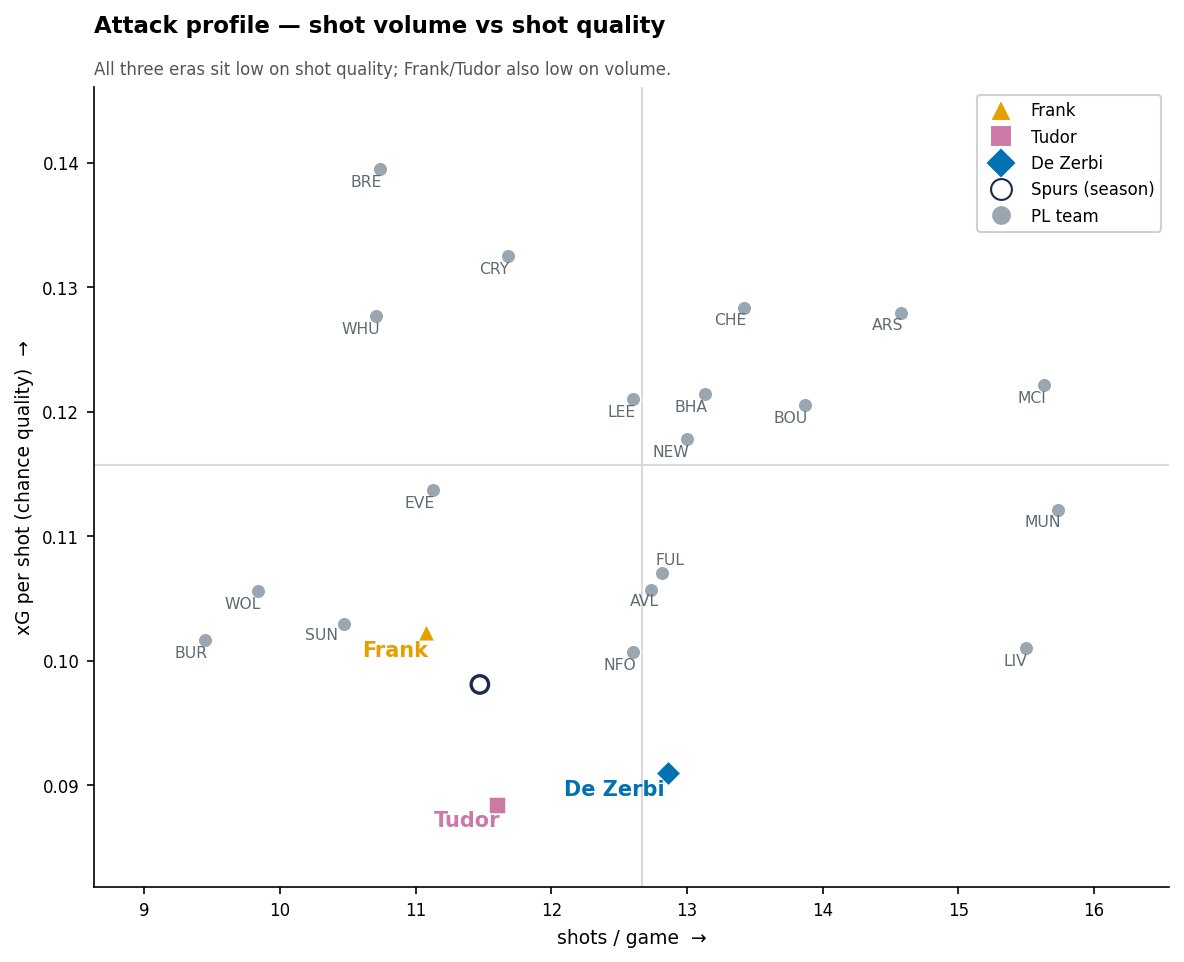
De Zerbi is most known for his team’s style when they have possession. It’s interesting that while shot volume increased to above the league average, shot quality actually decreased to worse than any individual team. It wasn’t an improvement in our attack that kept Tottenham up.

Given the little time available to the Italian, and the lack of a transfer window, this isn’t that surprising.

Defending

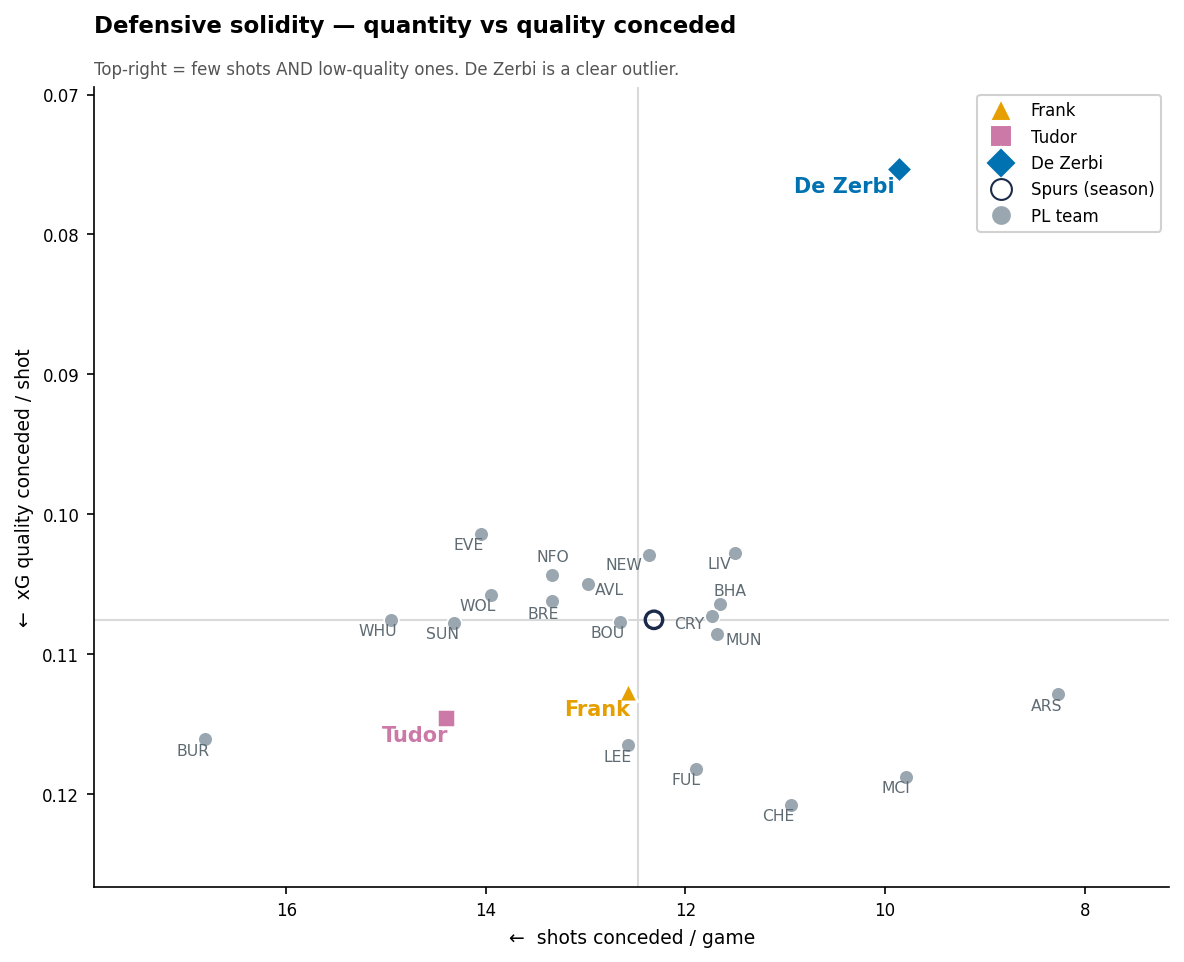
It was actually the defensive side of the ball that saw the most impact from the change of coach, and what an impact. Both the opposition’s shot volume, and the quality of those chance fell dramatically, to the extent that De Zerbi’s time in charge is a massive outlier. This is probably exaggerated by the small sample size, the context of a relegation battle, and the difficulty of the opponents faced. Even given those caveats, this seems a strong enough signal that something fundamental had changed.

Frank conceded around average shot volumes, but the chances conceded were above average opportunities to score. It’s interesting to see league leaders Arsenal and Manchester City gave up similarly high quality chances, but also noticeable that these were in much lower volumes.

Pressing and Winning The Ball

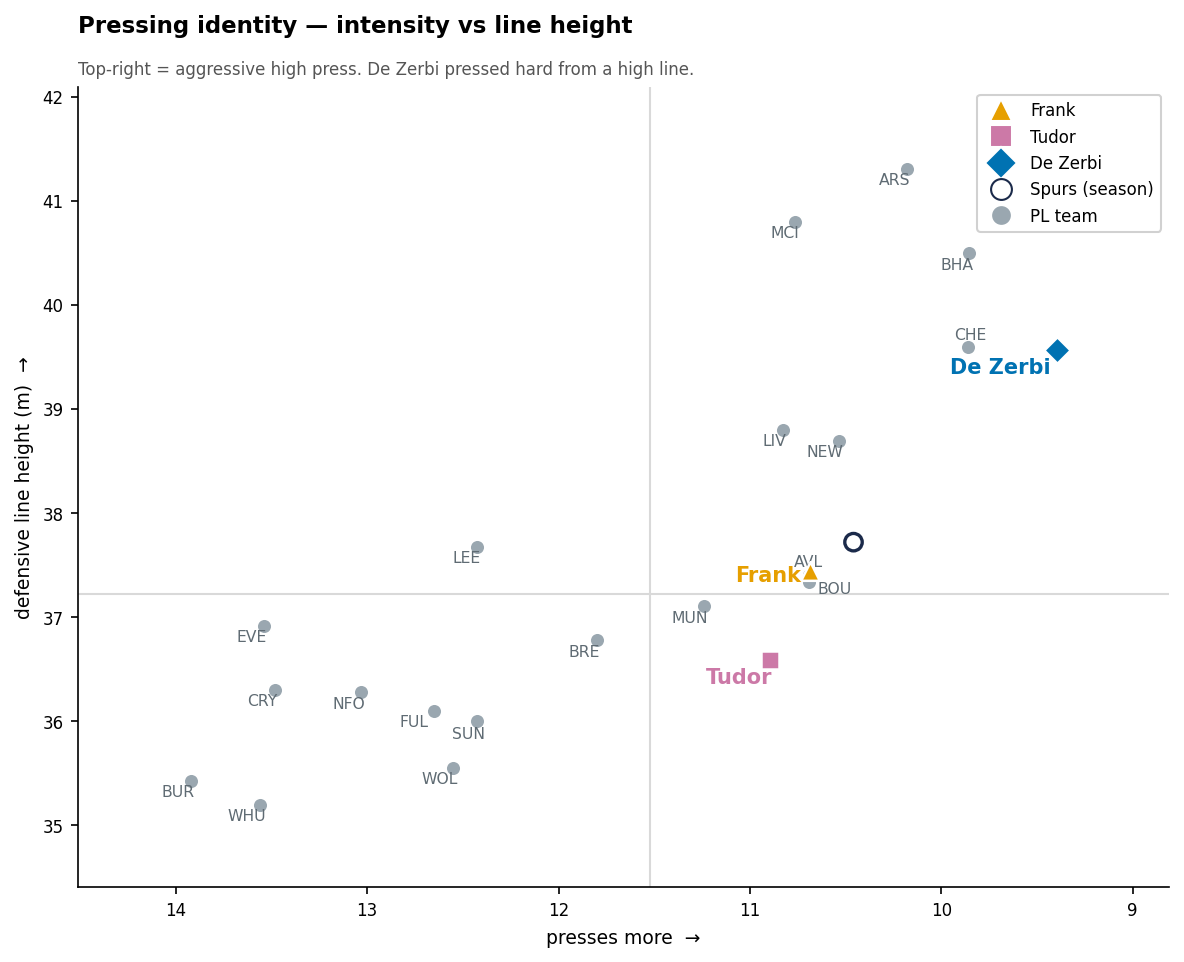
Here we are using PPDA (opposition passes allowed in the attacking 60% of the field per defensive action) to measure pressing. This captures how easy the opposition finds it to pass outside of the attacking part of the pitch, and is a good way to measure how intensely a team presses. A lower score means a more aggressive press.

De Zerbi scores a league best for PPDA, and his defensive line was high as well. Frank’s team were above average pressers, but his defensive line was around the mean.

Clearly once the Italian took charge, Spurs became an aggressive high pressing team.

Directness

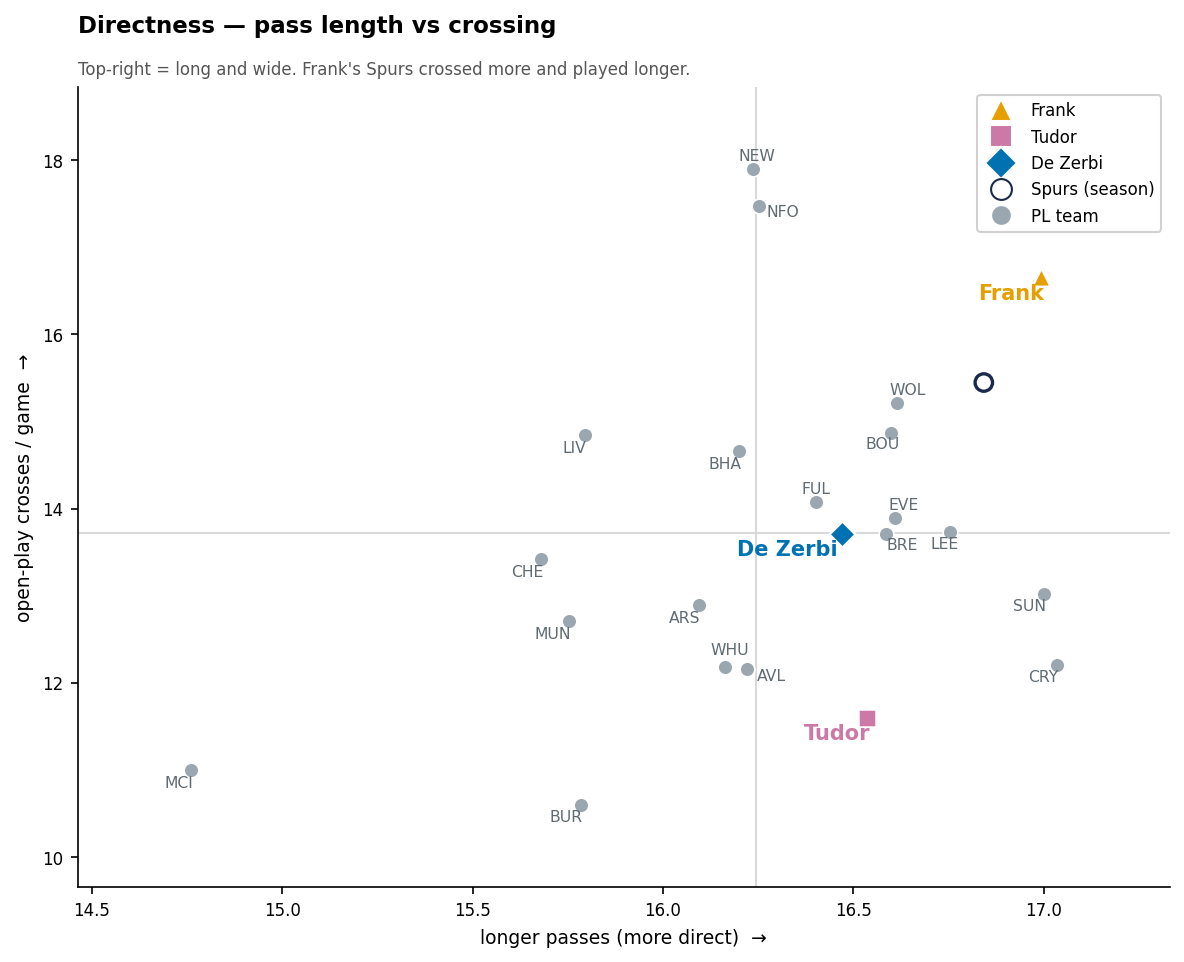
One thing that characterized Frank’s approach was a direct long ball strategy, and a lot of crosses. Whether this was intentional, or symptomatic of a lack ideas / quality on the ball is open to argument. The results aren’t.

Under De Zerbi we returned to the middle of the pack. Note how much of an outlier Pep’s Manchester City are here.

Possession

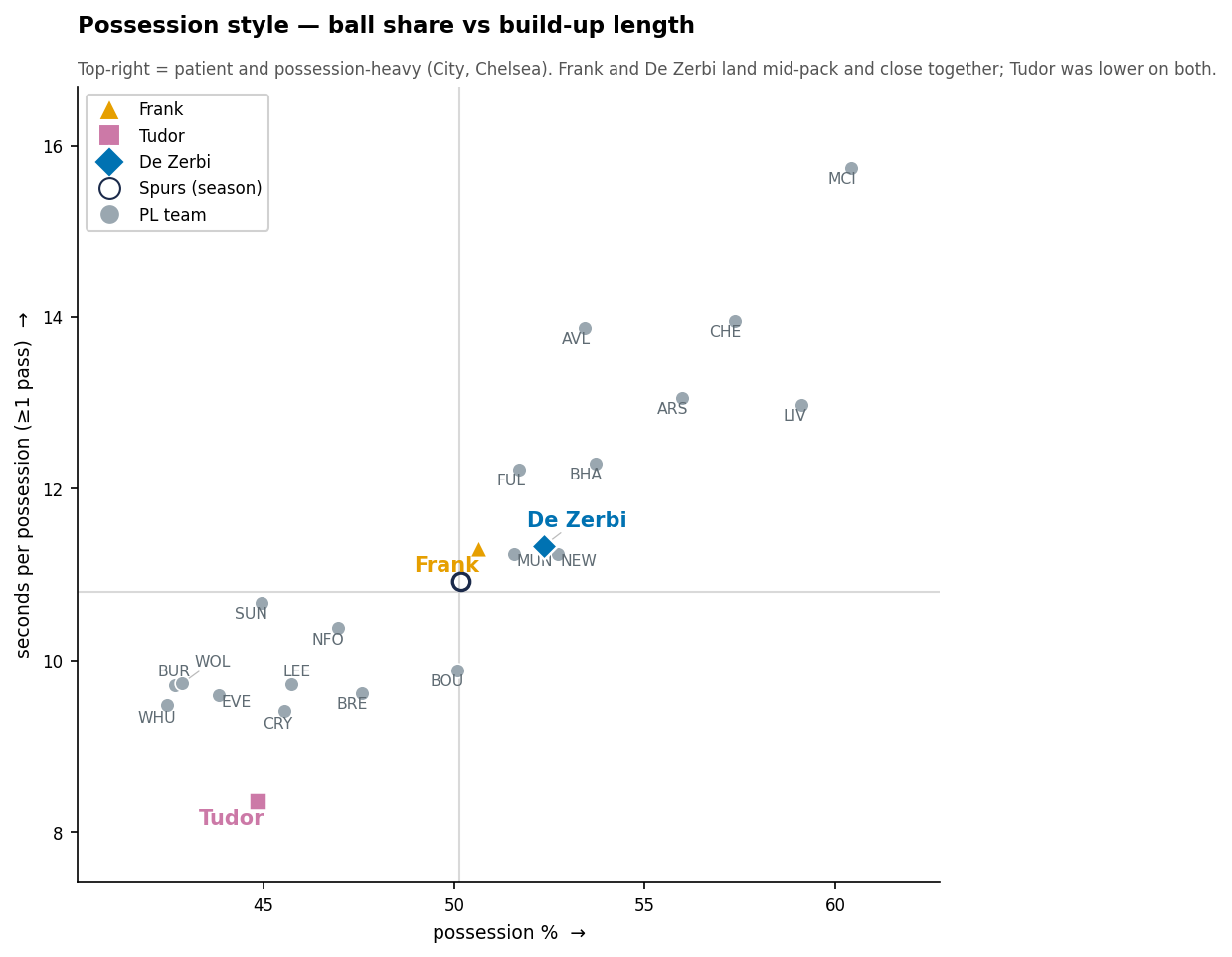
There wasn’t a massive uptick here, but De Zerbi’s team were a little more of a possession oriented side hopefully indicating the direction of travel. Frank was pretty much exactly average in this respect, although as an observer it often didn’t feel like it.

Manchester City are again massive outliers.

Conclusion

Thomas Frank’s team were failing full stop. It wasn’t just the results, the style of play was not likely to produce football that could challenge at the top of the division. His team created few shots, of low quality. Defensively they allowed the opposition high quality chances to score. Without the ball they pressed reasonably with a middling block, but with it they had average possession, and relied on long balls and crosses to create chances.

Roberto De Zerbi didn’t have the time or the personnel to make much change in the attacking output of the team, but he massively improved the defence. He did this through bravery, a high line and intensive press, rather than parking the bus. He also changed the style to be less reliant on long balls and crosses.

It will be really interesting to see how this will progress, given a transfer window and time to coach the team.

Premier League review by the numbers

We’re three games into the Premier League campaign and it’s still far too early to make any confident predictions but what interesting statistics have emerged so far?

Teams

New boys, Huddersfield lead the tackle count with 69. It looks like David Wagner has continued with the aggressive pressing style that served him so well in the Championship. In second place is another fan of the Gegenpress, Jurgen Klopp, whose Liverpool side sit on 63. Continue reading