In my last post I looked at some statistics that demonstrated how the performances at Spurs improved when we swapped the turgid football of Thomas Frank for the sunlit uplands of De Zerbi-ball. Continuing this theme, I thought I’d use some more advanced metrics to take a deeper dive into their contrasting styles, with the help of the wealth of data available online, and a copy of Claude Code.
Caveat: There is one big problem that makes this exercise interesting but not particularly scientific. Whilst we have a relatively large sample size for Frank, we have just seven games for De Zerbi, against arguably a relatively easy set of opponents. I still think it’s interesting to crunch the numbers but take them with a pinch of salt.
Caveat 2: I used data scraped from the various sites on the internet and built my own models using Claude Code. Therefore my models and data may not 100% align with others, although they do seem pretty close and I have carefully cross checked the logic / data.
Note: the graphs are presented with positive metrics being up and to the right, this sometimes means the numbers on the axes are reversed.
Attacking
De Zerbi is most known for his team’s style when they have possession. It’s interesting that while shot volume increased to above the league average, shot quality actually decreased to worse than any individual team. It wasn’t an improvement in our attack that kept Tottenham up.
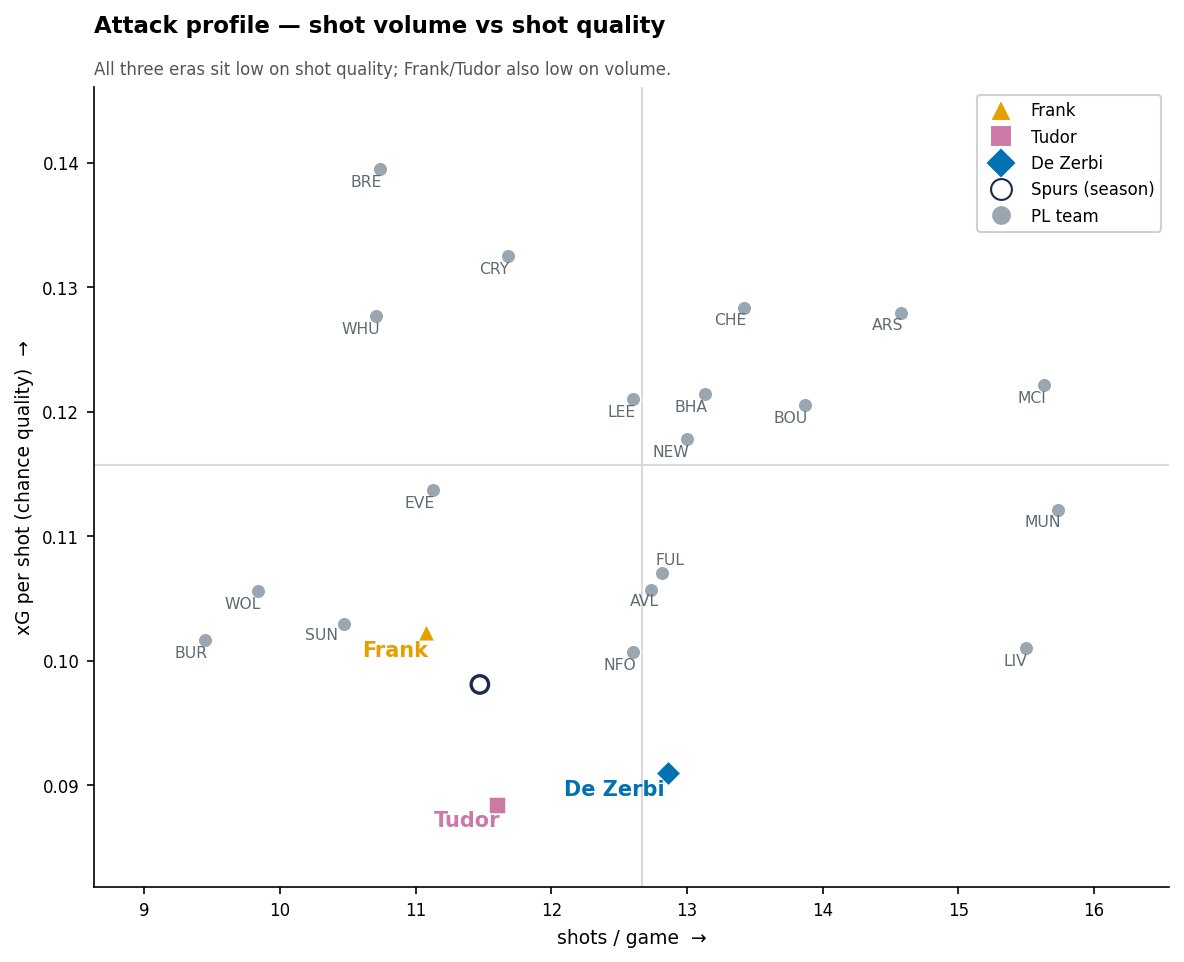
Given the little time available to the Italian, and the lack of a transfer window, this isn’t that surprising.
Defending
It was actually the defensive side of the ball that saw the most impact from the change of coach, and what an impact. Both the opposition’s shot volume, and the quality of those chance fell dramatically, to the extent that De Zerbi’s time in charge is a massive outlier. This is probably exaggerated by the small sample size, the context of a relegation battle, and the difficulty of the opponents faced. Even given those caveats, this seems a strong enough signal that something fundamental had changed.
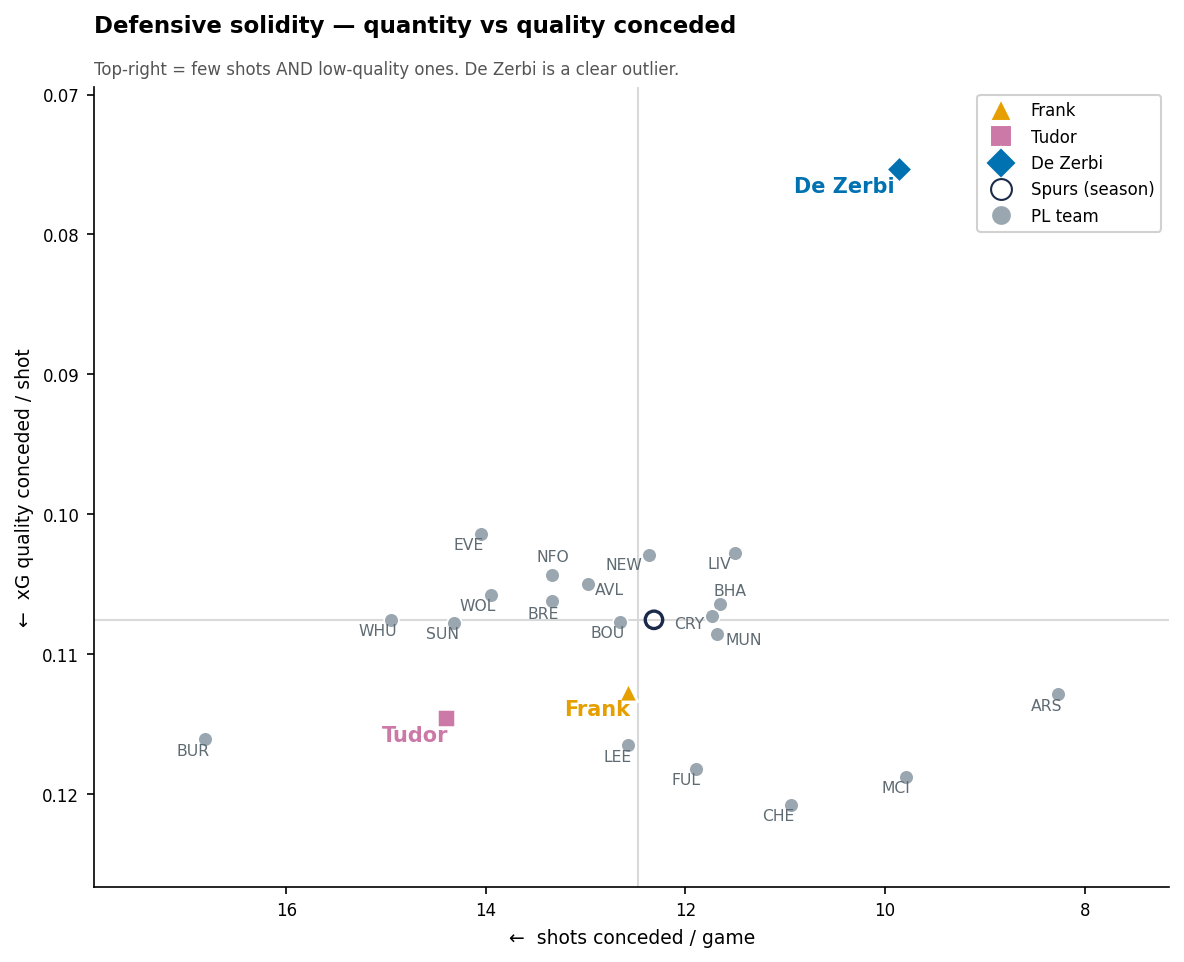
Frank conceded around average shot volumes, but the chances conceded were above average opportunities to score. It’s interesting to see league leaders Arsenal and Manchester City gave up similarly high quality chances, but also noticeable that these were in much lower volumes.
Pressing and Winning The Ball
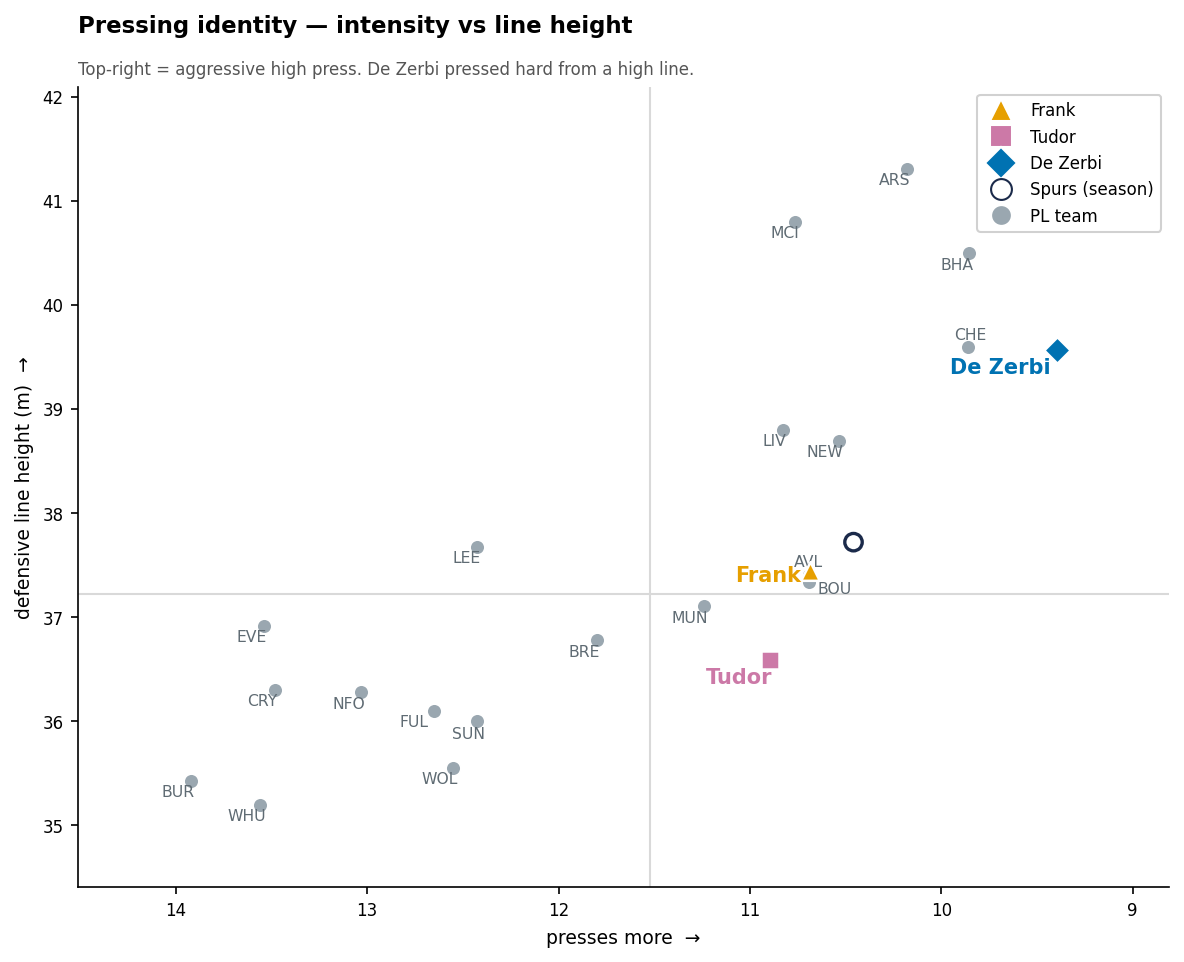
Here we are using PPDA (opposition passes allowed in the attacking 60% of the field per defensive action) to measure pressing. This captures how easy the opposition finds it to pass outside of the attacking part of the pitch, and is a good way to measure how intensely a team presses. A lower score means a more aggressive press.
De Zerbi scores a league best for PPDA, and his defensive line was high as well. Frank’s team were above average pressers, but his defensive line was around the mean.
Clearly once the Italian took charge, Spurs became an aggressive high pressing team.
Directness
One thing that characterized Frank’s approach was a direct long ball strategy, and a lot of crosses. Whether this was intentional, or symptomatic of a lack ideas / quality on the ball is open to argument. The results aren’t.
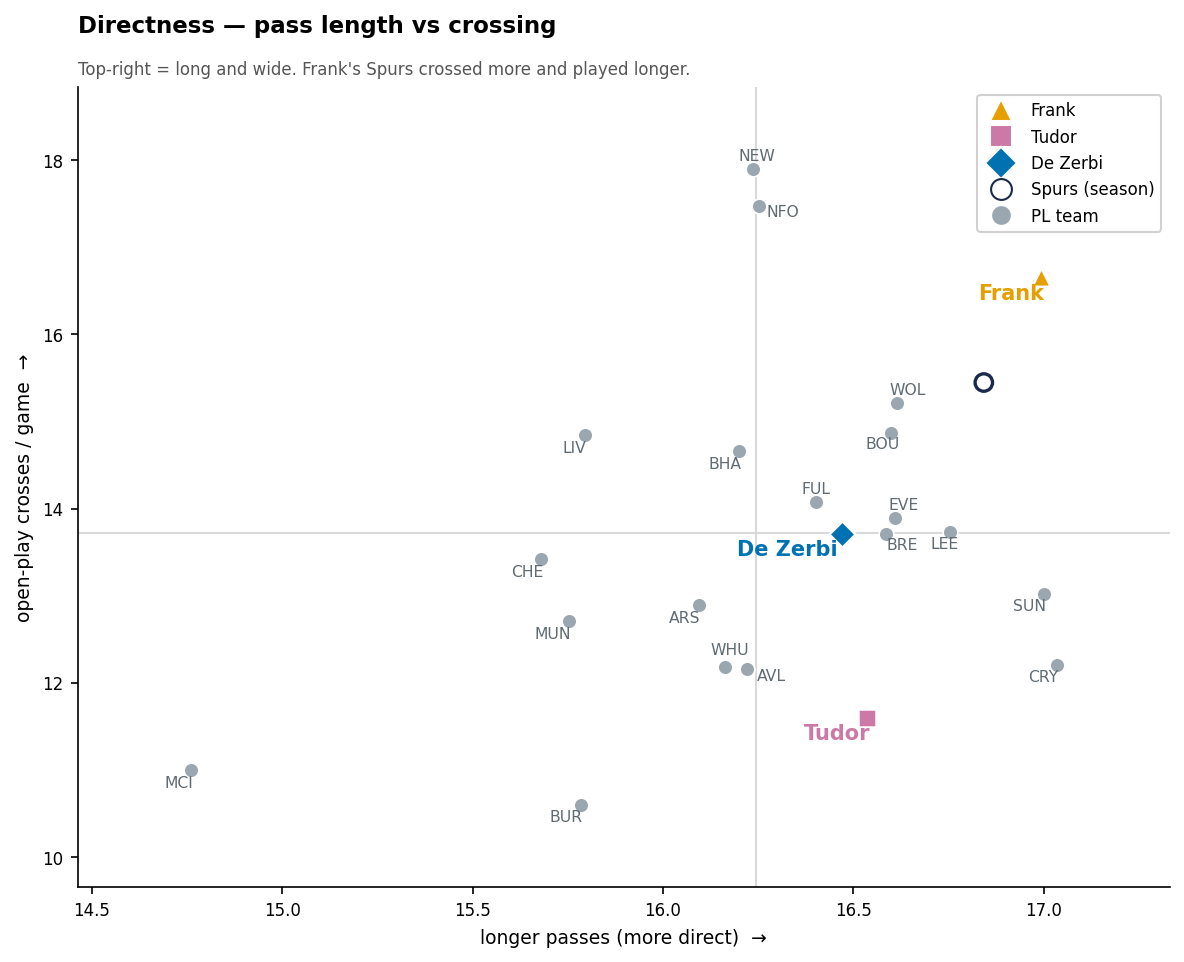
Under De Zerbi we returned to the middle of the pack. Note how much of an outlier Pep’s Manchester City are here.
Possession
There wasn’t a massive uptick here, but De Zerbi’s team were a little more of a possession oriented side hopefully indicating the direction of travel. Frank was pretty much exactly average in this respect, although as an observer it often didn’t feel like it.
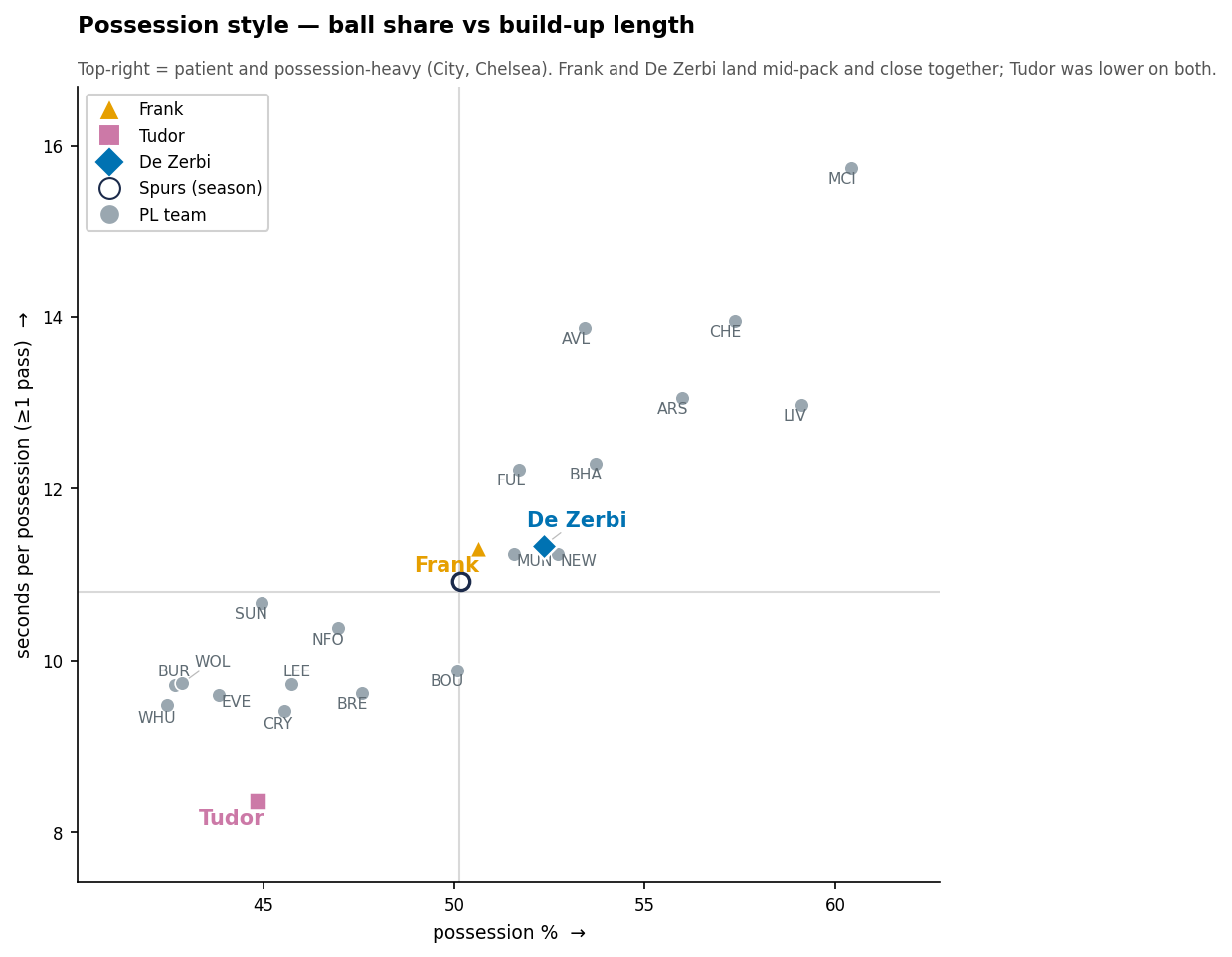
Manchester City are again massive outliers.
Conclusion
Thomas Frank’s team were failing full stop. It wasn’t just the results, the style of play was not likely to produce football that could challenge at the top of the division. His team created few shots, of low quality. Defensively they allowed the opposition high quality chances to score. Without the ball they pressed reasonably with a middling block, but with it they had average possession, and relied on long balls and crosses to create chances.
Roberto De Zerbi didn’t have the time or the personnel to make much change in the attacking output of the team, but he massively improved the defence. He did this through bravery, a high line and intensive press, rather than parking the bus. He also changed the style to be less reliant on long balls and crosses.
It will be really interesting to see how this will progress, given a transfer window and time to coach the team.

